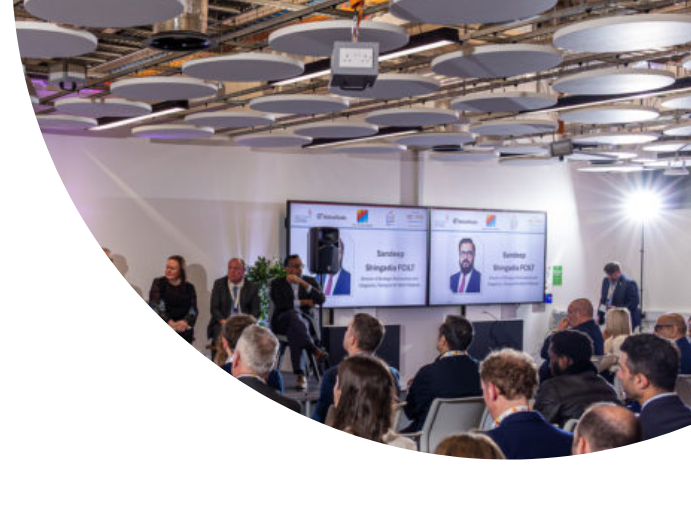
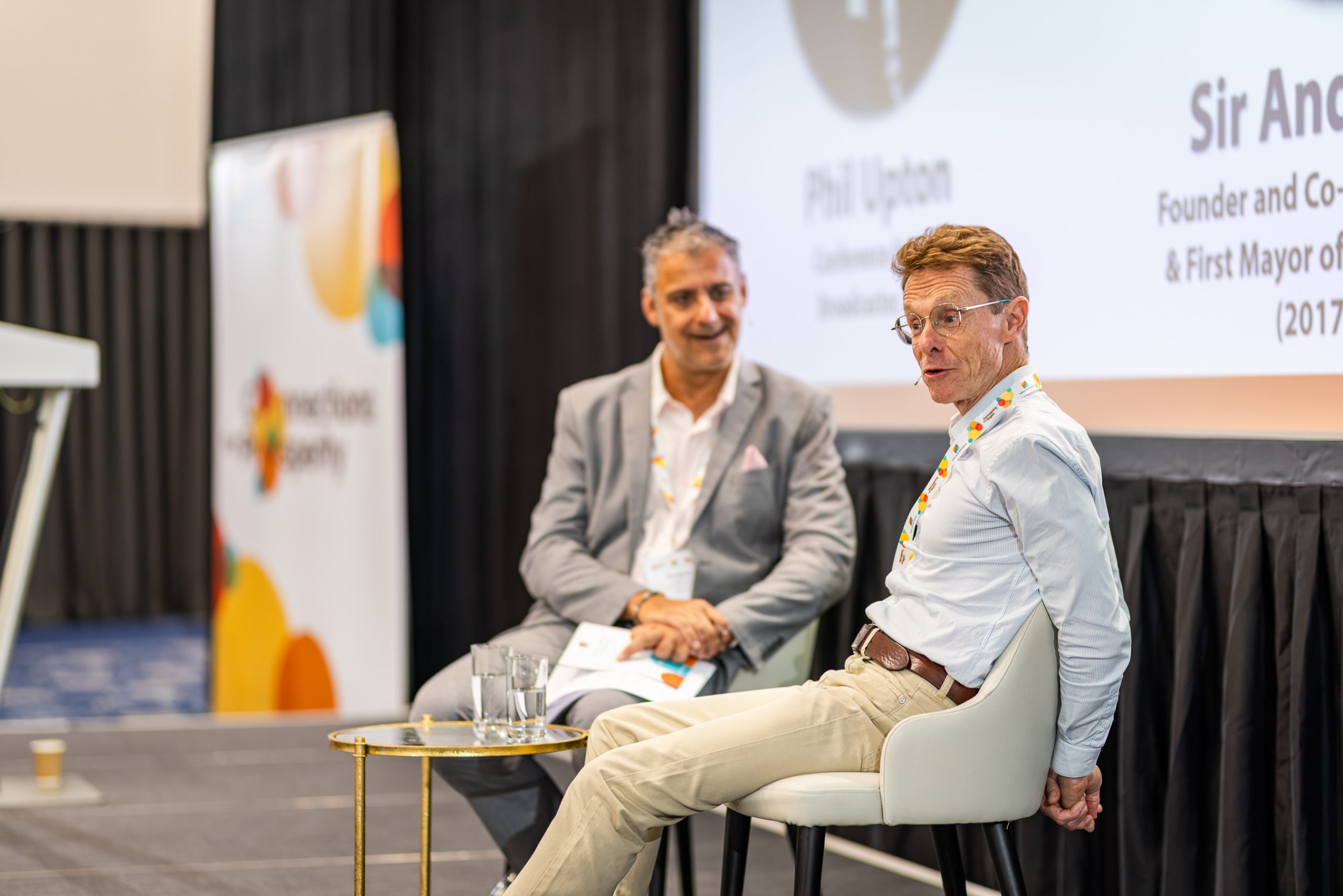
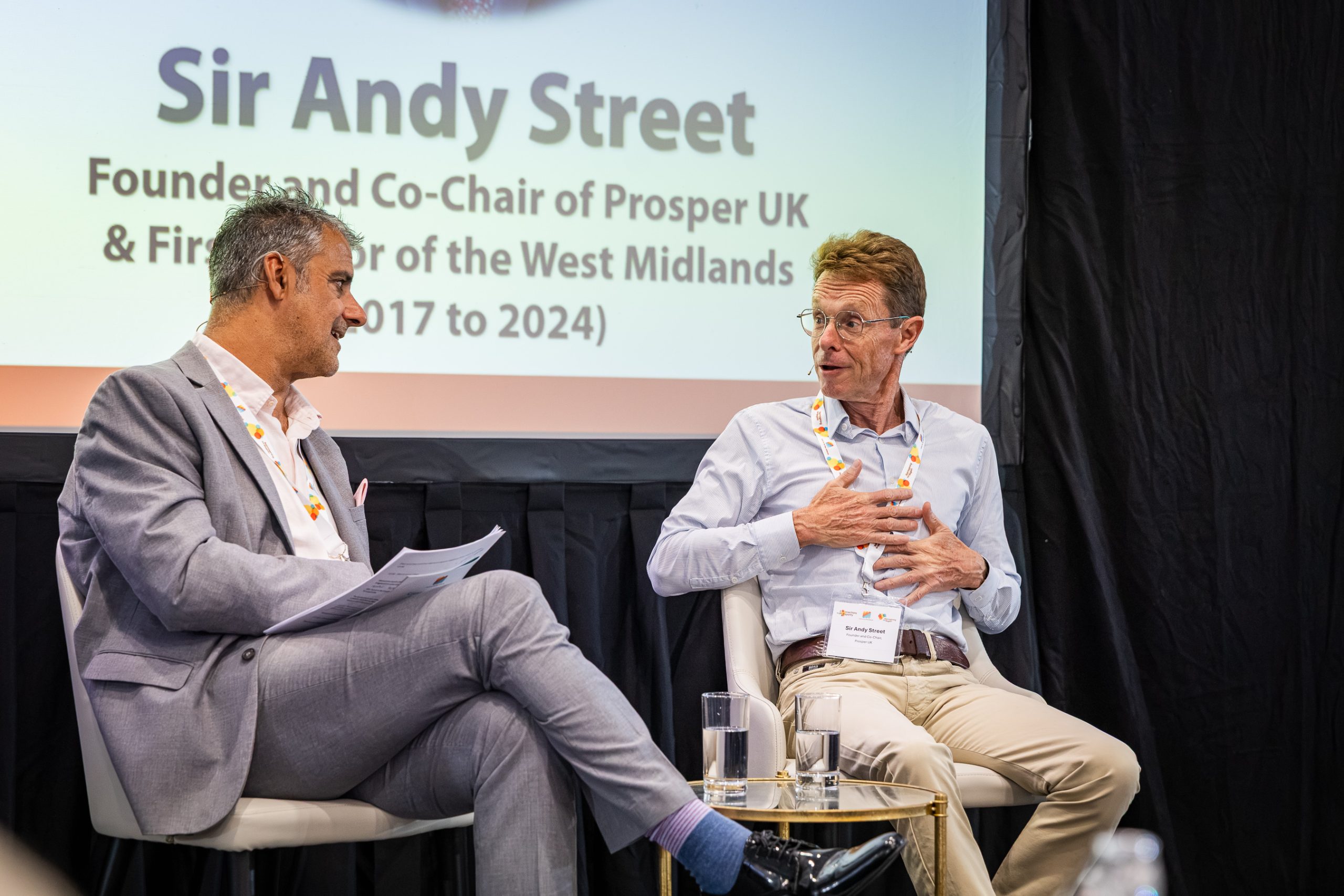
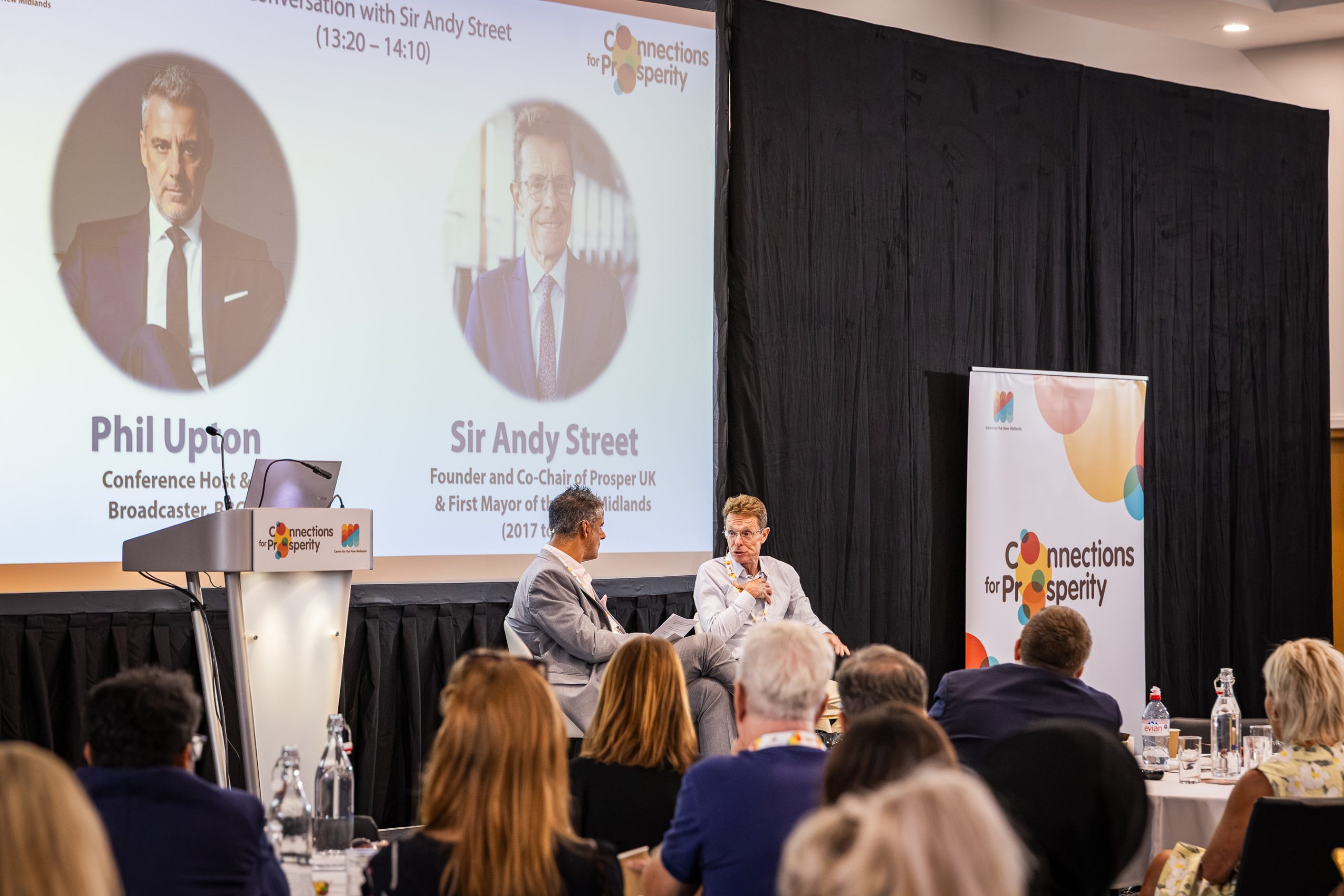
In a wide-ranging fireside discussion at the Centre for the New Midlands’ Connections for Prosperity conference, former West Midlands Mayor Sir Andy Street reflected on leadership, devolution, economic growth and the future of the centre-right in British politics.
Drawing on his experience in business and public office, he argued that the UK’s long-term prosperity depends on empowering regions, investing in innovation and telling a more compelling story about places like the West Midlands.
Devolution must evolve into fiscal independence
A central theme of the conversation was that devolution has delivered results, but remains incomplete. Street argued that local leaders have demonstrated they can make better decisions for their regions, yet are still constrained because funding is controlled by Whitehall.
His priority for the next phase of devolution is fiscal devolution—allowing regions to retain a share of the taxes they generate, rather than relying on bids to central government. He suggested that retaining a proportion of income tax would give regional authorities the certainty needed to plan long-term investments in transport, skills and economic development.
“The real maturity of devolution comes when regions keep some of the taxes they raise.”
Economic growth requires investment, innovation and infrastructure
Andy argued that prosperity cannot be delivered through a single policy. Instead, successful regions combine:
- world-class transport infrastructure
- investment in skills
- support for business growth
- strong innovation ecosystems
- a compelling identity that attracts people and investment.
While praising progress made on transport projects during his time as Mayor, he admitted he had been less successful in securing devolved funding for business innovation. He pointed to cities such as Austin, Texas, and Bordeaux as examples of places that have transformed themselves by investing heavily in innovation clusters and knowledge-based industries.
He also emphasised that the West Midlands’ emerging Knowledge Quarter should remain focused on attracting high-growth, research-led businesses rather than drifting towards general development.
The importance of telling a regional story
Andy repeatedly returned to the idea that economic success depends as much on confidence and reputation as policy.
Following the Birmingham 2022 Commonwealth Games, the West Midlands enjoyed rising inward investment, increasing numbers of young people choosing to stay in the region and strong international attention. He believes that momentum has faded and urged civic, business, university and sporting leaders to unite around a shared narrative.
His message was clear:
Regions that believe in themselves attract talent, investment and opportunity.
Leadership means delivering, not managing
Reflecting on the recent promotion of Andy Burnham to the role of Prime Minister, Andy argued that executive leadership is fundamentally about delivery.
He compared leading a city-region with leading a country, suggesting that although the scale differs enormously, the disciplines are remarkably similar: building a capable team, setting priorities, managing resources and ultimately getting things done.
His experience as Mayor reinforced his belief that devolved leaders can deliver practical outcomes because they are closer to the communities they serve.
Prosper UK and rebuilding the political centre-right
Andy also discussed Prosper UK, the organisation he launched after leaving office.
He described its aim as rebuilding a modern centre-right political tradition—socially liberal, fiscally responsible, pro-business and internationally engaged.
Rather than refighting Brexit or the political debates of previous decades, he argued that centre-right politics needs fresh answers to today’s challenges, including global competition, changing technology and geopolitical instability.
He characterised Prosper UK’s philosophy as one that combines:
- disciplined public finances
- low-tax incentives for growth
- support for business
- openness to international trade
- inclusive, non-divisive politics.
Six months after launching, he said Prosper UK had already attracted around 25,000 supporters, suggesting there remains significant appetite for that political space.
Government should learn from successful pilots
Andy expressed frustration that successful public policy pilots are too rarely expanded.
He cited the West Midlands’ Housing First programme, which significantly reduced rough sleeping during his mayoralty, as an example of an initiative that demonstrated measurable success but was not fully adopted nationally.
Drawing on his business background, he argued that organisations should scale successful innovations rather than continually reinventing policy with each change of minister.
Stability matters
Another recurring theme was the importance of stable leadership.
Andy contrasted frequent ministerial reshuffles in Whitehall with the relative continuity provided by directly elected mayors. He argued that consistent leadership allows long-term strategies to be developed and delivered—something businesses understand instinctively.
The business voice must remain central
Andy emphasised that business leaders should play a stronger role in shaping regional strategy.
He argued that procurement processes should do more to enable innovative smaller companies to compete, while regional authorities should have greater influence over research and innovation funding to help commercialise ideas emerging from local universities.
His broader message was that successful regions connect universities, entrepreneurs, investors and public institutions far more effectively than the UK currently does.
Key takeaways
The discussion centred on several interconnected themes:
- Complete the devolution journey by giving regions fiscal powers, not just spending responsibilities.
- Invest in innovation alongside transport and skills to create sustainable economic growth.
- Build a compelling regional identity that attracts investment, businesses and talented people.
- Provide stable, long-term leadership capable of delivering practical outcomes.
- Strengthen partnerships between business, universities and government.
- Learn from success, scaling effective policies rather than abandoning them with political change.
- Promote an optimistic, outward-looking vision for both the West Midlands and the UK.
If you and your organisation are not yet members of our Reimagining the Region network, click here to learn more about getting involved.
Our network is growing each and every month – make sure you are part of how we shape an even ‘better’ region for all.
To learn more about getting involved or to join our network, please contact Chris Smith (Founder and CEO, Centre for the New Midlands CIC) by emailing chris@thenewmidlands.org.uk