


International students are usually discussed through the lens of immigration, university finances or, increasingly, political debate. However, here in the West Midlands, I think we need to ask a different question.
What if we stopped seeing international students primarily as a higher education issue and started recognising them as part of our regional growth story?
New analysis undertaken by London Economics for the Higher Education Policy Institute (HEPI) and Kaplan International Pathways provides compelling evidence for doing just that. International students who began higher education courses in the UK in 2024/25 are expected to generate £40.4 billion in net economic benefit over the course of their studies. That is around £100,000 per international student, after estimated public costs are taken into account.
For the West Midlands, the numbers are particularly striking.
Around 36,100 international first-year students were living in the region in 2024/25. The report estimates that these students will generate a net benefit of £3.74 billion for the UK economy over the course of their studies. This is not a measure of money retained solely within the West Midlands, but it demonstrates the scale of national economic activity associated with international students living in our region.
At £3.74 billion, this is the largest regional net impact associated with anywhere in the UK outside London and the South East. That isn’t simply important to our universities. It matters to the West Midlands economy.
Bringing the numbers closer to home
The constituency-level analysis makes the story even more interesting. The table below is taken from this HEPI report
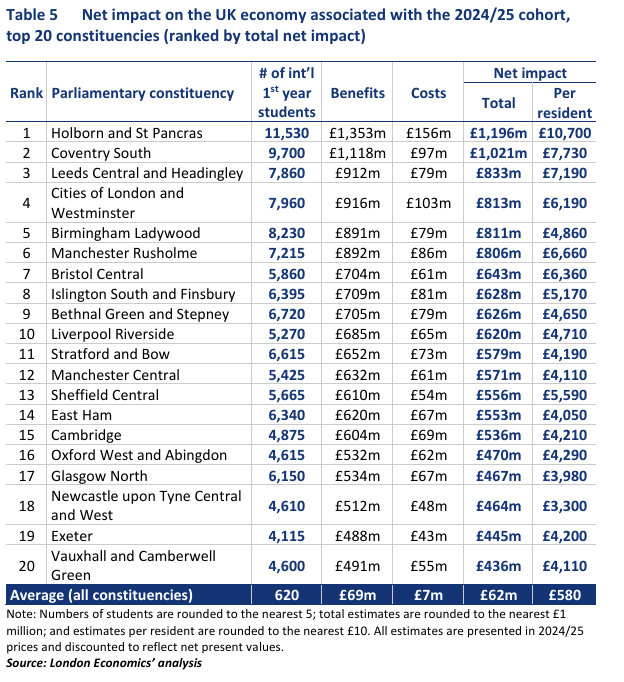
Coventry South ranks second of all 650 UK parliamentary constituencies for the economic impact associated with international students. Its 9,700 international first-year students are associated with a net impact on the UK economy of just over £1 billion. Then there is Birmingham Ladywood.
Some 8,230 international first-year students were living in the constituency in 2024/25. The analysis associates these students with £891 million in economic benefits and £79 million in estimated public costs, producing a net impact on the UK economy of around £811 million.
That puts Birmingham Ladywood fifth in the country. If the estimated net impact is divided by the constituency’s resident population, it is equivalent to around £4,860 per resident. Those figures are hard to ignore. Net benefit figures like these move the debate beyond immigration to one of significant economic implications and, more importantly, opportunity.
This needs a more grown-up conversation
None of this means international recruitment should be pursued at any cost. Questions about housing, infrastructure, public services and the wider impact of migration are legitimate. What is helpful about the London Economics analysis is that it attempts to account for costs as well as benefits.
Nationally, the 2024/25 cohort is estimated to generate £45.1 billion in economic benefits, against £4.7 billion in public costs, resulting in a benefit-to-cost ratio of approximately 9.7 to one.
That doesn’t remove the need for debate. But it should inform it. However, there is also a warning in the data for us all.
International first-year student numbers peaked in 2022/23 and have since fallen by 12%. London Economics estimates that, had those numbers been maintained, the net economic impact generated by the 2024/25 cohort would have been around £2.9 billion higher. As things stand this now represents a regional loss, or at least a significant lost economic opportunity. For a region focused on growth, skills and productivity, that should give us pause for thought.
Recruitment is only the beginning
The economic figures are only part of the story. In my view, international students should also form part of our regional thinking about skills, productivity, entrepreneurship, inward investment and graduate retention, rather than sitting in a separate box marked “international education”.
This matters particularly in a region still facing significant challenges around productivity, skills and economic inactivity, issues that are already central to the work of the Centre for the New Midlands.
Universities cannot address these challenges alone. Nor should we.
There is a much bigger opportunity for universities, employers and regional policymakers to work together to connect international students with West Midlands businesses, entrepreneurial opportunities and the skills our economy needs.
And we shouldn’t think about their value only in terms of those who remain here permanently.
An international graduate who develops a career here can become part of our regional skills base. One who starts a business can become an employer. Someone who eventually returns home may still become an advocate for Birmingham and the West Midlands, strengthening the international networks that support trade, investment and future collaboration. The regions visibility on global platforms can only support growth and investment.
The opportunity isn’t simply recruitment. It is what we do with those connections once students are here.
From international recruitment to regional advantage
The West Midlands has a compelling offer – strong universities, major employers, diverse communities, comparatively affordable living costs and excellent connectivity. Birmingham itself is an international city with global ambition.
The figures suggest international students are already contributing significantly to that story, so perhaps we need to think differently.
Rather than viewing international students principally through the separate lenses of immigration policy or university finances, we should recognise them as part of the wider economic and skills infrastructure of the West Midlands.
Once we do that then we need to ask ourselves more challenging questions –
- Are we connecting international students with enough West Midlands employers?
- Are we creating routes into sectors where the region needs skills?
- Are we enabling international graduates with entrepreneurial ambition to connect with the businesses, networks and support that already exist here?
- And, perhaps most importantly, are universities, employers and regional leaders working together closely enough to convert the international reach of our universities into longer-term regional advantage?
The figures from Coventry South and Birmingham Ladywood show that this isn’t an abstract national debate. It is happening on our doorstep, and its economic significance is considerable.
At University College Birmingham, this is continually shaping our own thinking. We are looking beyond international recruitment towards how our employer relationships, work-focused curriculum and new talent pathways can connect students more directly with the regional economy while they are here and, hopefully, beyond.
International students are already making an important contribution to the West Midlands. The bigger question is whether, as a region, we are making enough of the opportunity.
Sources and further reading
The economic figures used in this article are drawn from London Economics (2026), The benefits and costs of international higher education students to the UK economy, commissioned by HEPI and Kaplan International Pathways. The research uses 2024/25 international student data and provides regional and parliamentary constituency-level analysis.
Methodological note: Regional and constituency figures describe the impact on the UK economy associated with international students living in each area. They should not be interpreted as meaning that the full economic impact is retained within that particular region or constituency
This is a personal blog post. Any opinions, findings, and conclusion or recommendations expressed in this article are those of the authors and do not necessarily reflect the view of the Centre for the New Midlands or any of our associated organisations/individuals.
ABOUT OUR AUTHOR:
Professor Elaine Limond is Vice Dean of the Business School at University College Birmingham, where she leads strategy, employer engagement and employability across a strongly vocational portfolio. She has over 20 years’ experience working across further and higher education, with a clear focus on skills development, workforce readiness and progression into employment.
Elaine’s background also includes elite sport, having worked as a performance coach for the Rugby Football Union and England Under 20s. This experience informs her practical, outcomes focused approach to leadership, talent development and high performance cultures.
She is an experienced leadership coach and mentor, holds an Executive MBA, and currently serves as an independent college governor and charity trustee. Elaine is undertaking a Doctorate in Business Administration, focused on leadership and talent pipelines within education and skills systems.