Alan Milburn has done the country a service. His interim report puts hard numbers on what many of us have watched build for years. Over one million young people are now not in education, employment or training. On current trends, 1.25 million within five years.
But the most important number in that report is not the headline. It is this one: 84% of NEET young people want a job or training.
Read that again. The overwhelming majority of these young people want to work. So the next time someone reaches for the lazy generation narrative, show them that figure. The issue is not ambition. It is architecture.
Here is the other number that should stop us in our tracks. For every £1 we spend supporting a young person into work, we spend around £25 on benefits. We have built a system that pays for failure after the event instead of preparation before it. That is not a funding problem. It is a design problem.
After more than a decade working directly with young people, I can tell you what they are actually missing. Not talent. Not drive. Structure. Confidence. Language. Evidence. And someone who stays close enough to help them make sense of the route ahead.
I see it constantly. A young person who talks with real passion in a safe room, then goes silent in front of an employer. A learner with genuine skills and no idea how to evidence them. A student who has been through programmes, workshops and careers activity, and still cannot explain who they are, what they offer or where they are going next.
They have not failed to engage. The system has failed to connect.
We have spent years building activity around young people. We have never properly built the architecture around progression. The distinction matters more than anything else in this debate.
Activity is a workshop, a talk, a visit, a placement, a programme. Progression is what happens afterwards. Can the young person name their skills? Evidence them? Sit in front of an employer without their confidence collapsing? Move from education into work without feeling they have stepped off a cliff?
We fund activity because activity is easy to count. Sessions delivered. Young people reached. Boxes ticked. Progression is harder to count, so we count it less, and because we count it less, we build it less. That is how a country ends up with a million young people outside the system and a filing cabinet full of completed programmes.
This is the test now facing the Youth Guarantee. The money is real and the intent is genuine. But if it becomes another layer of referrals, signposting and short-term provision, we will be back here in five years counting a bigger number. If it builds deliberate architecture, starting before young people become NEET, relational, practical and evidenced at every step, it could be the reset this generation needs.
Young people need more than inspiration. They need preparation.
More than signposting. They need handholding at the points where confidence is most fragile.
More than qualifications. They need to translate what they have learned into language employers understand.
More than programmes. They need a system.
For the Midlands, where youth unemployment sits stubbornly above the national average, this should be a moment of serious ambition. We have the employers, colleges, universities, charities and civic institutions to lead the country on this. But we have to stop confusing partnership with people being in the same room.
Real partnership is shared responsibility for outcomes. It is knowing who prepares the young person, who opens the door, who supports the first step, who evidences progress, and who stays close enough to know whether it worked. If nobody can answer those five questions, it is not a system. It is a seating plan.
At EmployabilityUK we have built our work in exactly that space, and we see what happens when young people get structure, trusted adults, meaningful employer exposure and practical ways to evidence their skills. They do not just become more employable. They start to see themselves differently. That is the part no statistic captures, and the part that changes everything.
Milburn’s solutions are due later this year. My ask is simple. Do not give us more activity. Give us alignment. Until a young person can move clearly from aspiration to exposure, from exposure to practice, from practice to evidence, and from evidence to progression, we do not have an employability system.
We have fragments. And fragments do not build futures.
This is a personal blog post. Any opinions, findings, and conclusion or recommendations expressed in this article are those of the authors and do not necessarily reflect the view of the Centre for the New Midlands or any of our associated organisations/individuals.
ABOUT OUR AUTHOR:
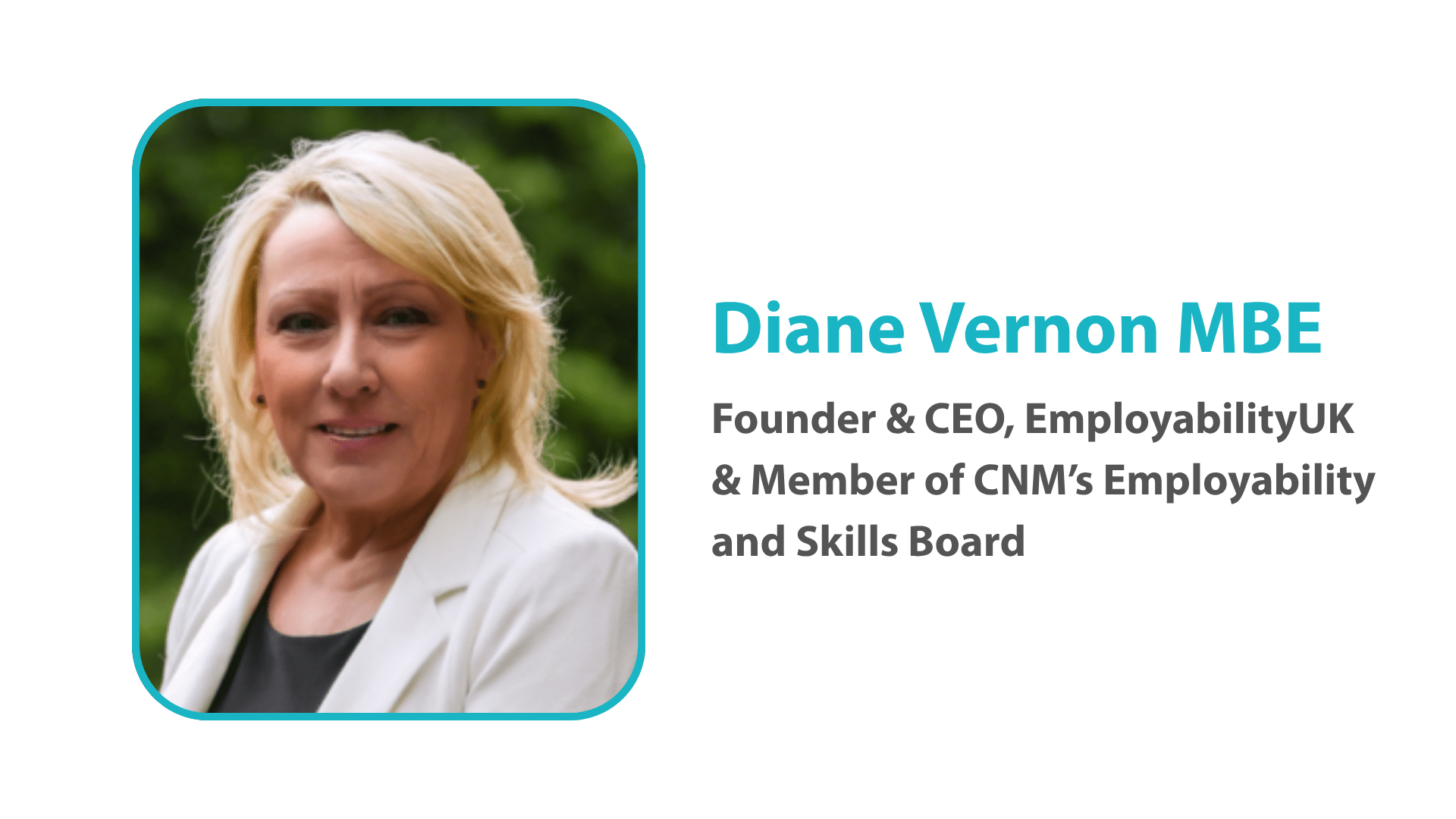
Di Vernon MBE, FIEP is a highly respected leader with over 25 years’ corporate experience at BT and O2, delivering high-impact education and community programmes across the UK. She advises on several boards and works as a social value consultant and charity advisor, guiding organisations to design effective partnerships, strengthen workforce pipelines and deliver measurable social impact, with a strong focus on improving outcomes for young people.
In 2013, Di developed Career Ready’s National Programme before founding the award-winning charity EmployabilityUK, which she leads as Chief Executive.
Her work includes an innovative employability programme for Coventry Building Society, recognised with the Business in the Community Responsible Business Award for Education Partnerships in 2018, and leading EmployabilityUK to receive The Queen’s Award for Voluntary Service in 2021.
Di is the creator of VITA and the EmployabilityUK Skills Passport (ESP), and the architect of National Employability Week™, as well as co-founder of National Work Experience Month. Together, these initiatives are shaping a national approach to employability, connecting education and industry and improving outcomes for young people.
Awarded an MBE in The Queen’s Platinum Jubilee Honours and made a Fellow of the Institute of Employability Professionals in 2024, Di works with corporates, education providers and public sector partners to align strategy, delivery and impact – ensuring Social Value, ESG and CSR commitments translate into meaningful, evidence-led outcomes.