“Talent is everywhere. Opportunity isn’t.”
It’s a phrase I return to often because it captures a major challenge facing young people today.
We do not lack talent, potential or ambition. We lack enough routes for that talent to be seen, developed and given a fair chance to succeed.
For years, the employability debate has focused heavily on whether young people are “work-ready” or “employer-ready”. Do they have the right attitude? Can they communicate well? Are they resilient enough? Do they understand workplace expectations – punctuality, teamwork, problem-solving and sticking at something when it gets difficult?
These questions matter. Anyone working closely with young people will know that many do need support to build the skills and habits that help them succeed in work. We should not pretend otherwise.
But there is another question we ask far less often – and it is arguably the more uncomfortable one:
Are employers young-people-ready?
This is not about shifting responsibility from young people to employers. It is about recognising that successful transitions into work depend on both.
The Supply-Side Fallacy
That question matters because too much of our current policy debate treats the young person as the “problem to be fixed”, while the labour market sits waiting – open and neutral.
The recent Alan Milburn interim report on young people and work should be an urgent wake-up call. It warns that Britain risks creating a “lost generation” detached from work and learning. Latest figures show over one million young people are NEET – not in education, employment or training; nearly 60% are economically inactive, and six in ten have never had a job.
That statistic should stop regional leaders in their tracks. If a young person has never held a job, had meaningful work experience, built a relationship with an employer, or had help translating raw potential into opportunity, the issue isn’t simply a lack of “work-readiness”. It is a structural lack of exposure, networks, early chances and supportive entry routes into work.
This matters in the West Midlands not only as a social mobility issue, but as an economic one. With many sectors facing workforce pressures, skills shortages and growing competition for talent, expanding opportunity is increasingly a business imperative. In a region where many young people grow up in communities facing entrenched disadvantage, limited professional networks, transport costs, caring responsibilities or poor mental health can make the journey into work significantly harder.
When “Entry-Level” Isn’t Entry-Level
Too often, entry-level roles are no longer truly entry-level. They demand prior experience that young people haven’t had the chance to gain. Recruitment often rewards confidence and polish over raw potential, partly because busy hiring managers lack the time, capacity or tools to assess trainability. Interviews can then favour candidates who already understand the unwritten rules of corporate culture, where “culture fit” can unintentionally become a proxy for familiarity.
Too many young people are therefore judged on what they appear to lack, rather than what they could become with the right environment and support.
This is not about lowering standards; it is about widening the route to meeting them.
Employers are right to want reliable, motivated staff. Young people need to bring curiosity, willingness to learn and the effort required to adapt to workplace realities. For some, that will also mean taking greater personal responsibility for their own development. But those qualities do not develop in a vacuum. They are forged through experience, relationships, constructive feedback and trust. At the same time, workplace realities have changed too. Expectations, priorities and ways of working are shifting, and many young people bring strengths that employers increasingly need: digital confidence, comfort with technology, adaptability and an instinct for more efficient ways of doing things. For them, technology is not a specialist add-on; it is part of daily life. Opportunity is a two-way street – employers must provide the structure, support and clarity that make that transition possible, while also recognising what young people can contribute as they learn.
Employers need to join the development journey earlier: offering meaningful work experience, designing entry routes that value potential, and equipping line managers to support young people navigating professional norms for the first time.
Confidence often comes after opportunity. We frequently mistake a lack of confidence for a lack of ability. Yet many young people simply need the chance to prove themselves where expectations are clear, support is structured and an employer is willing to take a calculated risk.
Building a Regional Bridge
As the Milburn report powerfully argues, the demand side of the labour market matters just as much as the supply side. For too long, policy has treated youth disengagement purely as a supply issue: more CV workshops, more job search conditionality, more basic skills courses. While those have their place, even the best-prepared young person will struggle if the labour market has fewer accessible entry points than it once did.
This is where regional partnerships become essential. No employer, youth organisation, college or local authority can solve this alone. The West Midlands needs a stronger bridge connecting young people, employers and trusted community organisations. If the region needs more people in construction, manufacturing, health, social care, digital or green industries, then careers advice, vocational pathways and work experience need to reflect that earlier. Young people cannot choose routes they cannot see, and employers cannot recruit from pipelines that have not been built.
Sport, mentoring, and community youth work play a vital role in building that bridge. At their best, they create safe, high-expectation environments where young people build trust, discipline, teamwork, and emotional resilience. These are not just “soft skills” – they are essential human skills that help a young person handle pressure, communicate across generations and persevere through setbacks.
However, community organisations are currently expected to do too much of the heavy lifting. They prepare young people for employers, while many recruitment and onboarding models can struggle to keep pace with the needs of today’s young talent. If we are serious about tackling regional economic inactivity, employers must be an active part of the solution, not just the final destination.
What Does a “Young-People-Ready” Employer Look Like?
A young-people-ready employer is one that:
- Re-evaluates entry-level criteria: Assesses whether roles truly require prior experience or if potential, character, and trainability are sufficient.
- Opens early access: Provides workplace exposure and mentoring to young people who lack personal professional networks.
- Empowers line managers: Gives managers the tools and training to support younger workers dealing with workplace anxiety or unfamiliarity with professional norms.
- Builds authentic local partnerships: Integrates local charities and colleges into their long-term talent strategy, rather than treating engagement as a CSR afterthought.
- Values reciprocal learning: Sees young workers as talent to nurture, and as people who can bring digital confidence, fresh thinking and more efficient ways of working.
Leading the Way in the West Midlands
There is a pervasive narrative that young people today are less resilient, less motivated, or less prepared than previous generations. While we must be honest about the complex mental health and social challenges many face, that narrative is incomplete. Many young people are simply growing up with fewer informal opportunities, fewer entry routes into stable work, and a labour market that expects them to arrive fully formed.
That is not a fair test of talent.
The West Midlands has the chance to lead the UK in showing a better way forward, not through another short-term initiative, but through a shared commitment to making opportunity visible, practical and reachable. That means intervening early, supporting those at risk of disengaging before they fall off the radar, and co-creating genuine pathways into long-term careers.
Young people do need to be ready for work. But work must also be ready for young people.
Because talent is everywhere in the West Midlands – our job now is to ensure opportunity is too.
This is a personal blog post. Any opinions, findings, and conclusion or recommendations expressed in this article are those of the authors and do not necessarily reflect the view of the Centre for the New Midlands or any of our associated organisations/individuals.
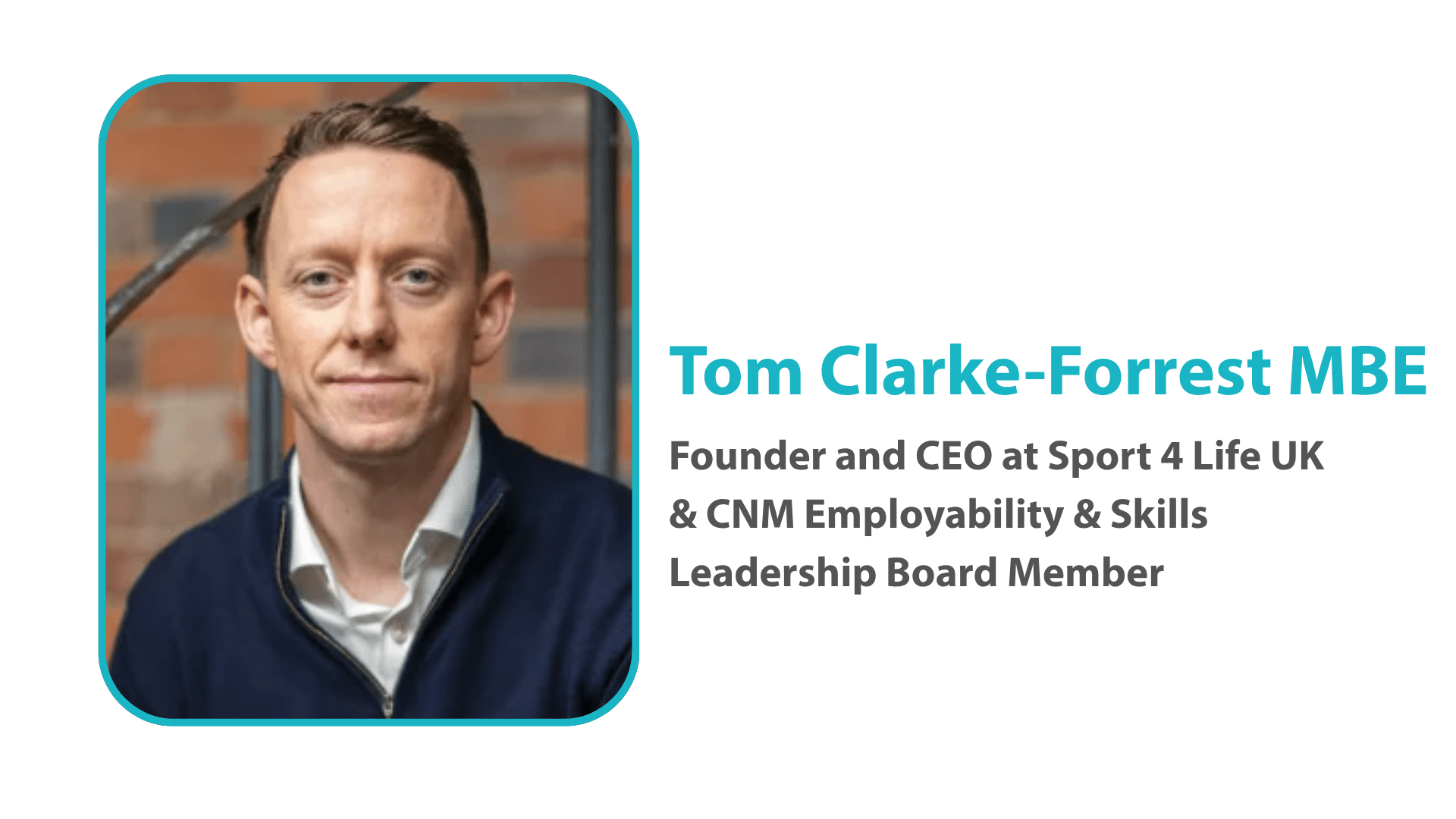
ABOUT OUR AUTHOR:
Tom Clarke-Forrest MBE is the Founder & CEO of Sport 4 Life UK, a leading sport-for-development charity in the West Midlands. Since inception in 2006, under his leadership the organisation has grown geographically, operationally and financially – employing over 20 full-time staff, a revenue of c.£1.5m each year, and developed a proven delivery model for its work with 11 to 29 year olds.
S4L currently supports over four thousand young people each year, empowering them to reach their potential by providing the skills, qualifications, and support needed to find work and shape successful futures. In recent years, the organisation has also expanded its reach nationally through its innovative ‘impact partners’ programme, collaborating with other sport-for-development organisations in the sector. Tom was awarded an MBE in the 2026 New Year’s Honours List for services to young people and sport.