There is a persistent and comfortable belief in both business and regional development that when growth slows, the problem must be execution. The assumption is that organisations are not moving fast enough, not collaborating effectively enough, or not investing in the right capabilities. This explanation is reassuring because it suggests the solution is familiar: improve performance, refine strategy, increase coordination, and push harder. But this assumption is increasingly incomplete.
In reality, most organisations and systems are not struggling because they lack effort. They are struggling because they are exceptionally good at solving problems that no longer fully exist in the way they once did. And the more capable the organisation, the more dangerous this becomes. High-performing systems do not fail loudly. They optimise themselves into obsolescence quietly.
We have seen this pattern repeatedly in markets and industries that once believed their dominance was secure. Nokia is one of the clearest examples. It did not fail because it stopped innovating or because it lost engineering capability. It failed because it continued to define its problem as building better mobile phones at a time when the mobile phone had already become something fundamentally different. The category shifted from hardware performance to software ecosystems, user experience, and platform value creation. Nokia was still answering the right question for the world that no longer existed.
A similar dynamic played out with Habitat. Habitat was not a weak or poorly executed business. On the contrary, it was highly influential in shaping modern British design culture. However, it operated on the assumption that customers primarily valued design-led curation. Over time, the market reweighted value towards convenience, immediacy, affordability, and accessibility. Competitors such as IKEA scaled industrial efficiency and accessibility, while Amazon fundamentally redefined expectations of availability and delivery. Habitat continued to improve its original value proposition, but the definition of value had already shifted beneath it.
The same structural lesson is even more clearly illustrated by Blockbuster. Blockbuster did not collapse because it failed at running stores. It collapsed because it remained committed to a belief that its role was to optimise access to physical video rental locations. Meanwhile, Netflix reframed the entire category by asking a different question altogether: why should access to entertainment require physical infrastructure at all? That shift from improving a system to eliminating its constraints is the difference between incremental improvement and structural disruption. These are not isolated business stories. They are expressions of a deeper pattern that is now visible across economies, sectors, and regions.
The same dynamic is increasingly present across the UK economy, particularly within small and medium-sized enterprises and regional systems. A local retailer is no longer competing primarily with other local retailers; it is competing with the expectation of instant delivery and infinite choice created by global platforms. A professional services firm is no longer judged solely on expertise, but on responsiveness, visibility, and real-time insight. A trades business is no longer sustained purely by reputation, but by digital trust signals, speed of response, and platform visibility.
In each case, the nature of competition has shifted, but the way many organisations define their problem has not kept pace with that shift. They are still optimising for a world in which value was local, linear, and relatively stable, while operating in a world where value is global, dynamic, and continuously redefined by customer expectation. This creates a subtle but critical distortion. Organisations do not feel as though they are doing anything wrong. On the contrary, they are often working harder than ever. They are investing in improvement, adopting new tools, and refining execution. Yet the returns diminish. This is not an execution failure. It is a definition failure.
At a regional level, this has profound implications for places such as the Midlands. The Midlands is not lacking in capability, institutional strength, industrial depth, or ambition. It is one of the most structurally important economic regions in the UK, with a diverse base of manufacturing, services, logistics, and innovation assets. The challenge is not absence of activity. The challenge is whether the system is consistently aligned around the right problems to solve in order to unlock modern growth. Persistent skills gaps, uneven productivity, housing pressure, and SME growth constraints are often treated as separate issues requiring separate interventions. Yet increasingly, they share a common root. They are symptoms of systems that are not fully aligned to how value is now created, distributed, and experienced.
Skills systems are still often designed around supply pipelines, while employers operate in real-time capability gaps. Housing strategies are frequently framed around delivery targets, while communities experience them as long-term systems of affordability, connectivity, and opportunity. SMEs are supported through initiatives that assume stable competitive conditions, while they operate in markets shaped by global expectation benchmarks. In each case, effort is not the limiting factor. Alignment is.
Across all of this, there are five structural shifts that are redefining what growth actually means.
- The first is a shift from activity to clarity. In an environment of increasing complexity, value is created not by adding more information, but by reducing confusion and increasing decision clarity.
- The second is a shift from product to experience. Organisations are no longer compared only with direct competitors, but with the best experience a customer has had anywhere.
- The third is a shift from efficiency to adaptability. Efficiency optimises the current system. Adaptability determines whether that system can remain relevant when conditions change.
- The fourth is a shift from knowledge to problem solving. The constraint is no longer access to information, but the speed and quality with which organisations convert thinking into action.
- The fifth is a shift from leadership-centric thinking to distributed intelligence. Growth increasingly depends on how effectively organisations mobilise thinking across every level, not just within senior teams.
Taken together, these shifts redefine the nature of growth itself. Growth is no longer primarily a function of scaling what already works. It is increasingly a function of how quickly organisations and systems can recognise that what worked before may no longer be the right thing to scale.
This leads to a more uncomfortable but more useful question for leaders in both business and regional development. The question is not simply how to grow faster, but whether the underlying definition of the growth problem is still valid. Because if the problem is mis defined, then even highly effective execution will produce limited impact. Investment will be misallocated, policy will target the wrong constraints, and organisations will optimise behaviours that no longer lead to meaningful progress. The result is not failure. It is inefficiency at scale.
This is why the role of organisations such as the Centre for the New Midlands is becoming increasingly significant. In complex systems, growth is no longer driven only by delivery capability. It is driven by the ability to continuously surface, challenge, and redefine the problems that shape collective action. The most important contribution such organisations can make is not simply to convene stakeholders or amplify existing strategies, but to improve the quality and speed of problem definition across the system itself. This requires creating space where assumptions can be challenged, where constraints are properly understood, and where the framing of issues is not taken for granted. Because in a rapidly changing environment, the most powerful advantage a region can develop is not simply better answers. It is better questions, asked earlier, and acted upon more quickly.
The historical lesson from Nokia, Habitat, and Blockbuster is not that these organisations lacked capability. It is that they continued to refine answers to questions the world had already moved beyond. That is the quiet risk facing many organisations and systems today, including regional economies that are otherwise full of talent, ambition, and infrastructure. But it is also the opportunity. Because when growth is constrained by how problems are defined, then the most powerful lever available is not incremental improvement. It is redefinition. And the regions, organisations, and leaders that develop the discipline to see that earlier than others will not simply perform better within existing systems. They will shape what those systems become next.
This is a personal blog post. Any opinions, findings, and conclusion or recommendations expressed in this article are those of the authors and do not necessarily reflect the view of the Centre for the New Midlands or any of our associated organisations/individuals.
ABOUT OUR AUTHOR:
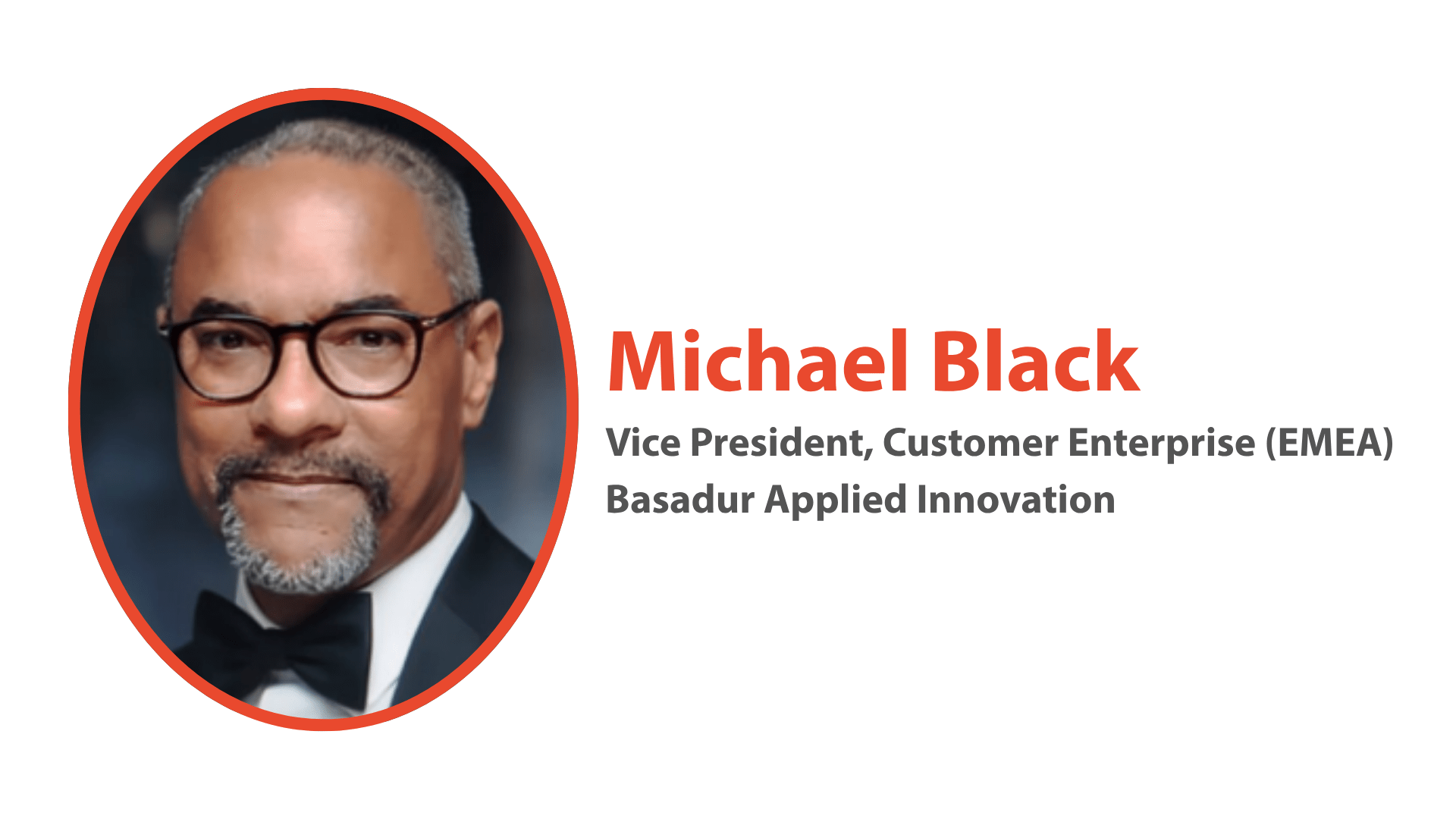
Michael Black is Vice President, Customer Enterprise (EMEA) at Basadur, where he is leading a challenge to the way organisations think about innovation, performance, and change across Europe, the Middle East, and Africa.
He works with senior leaders in corporations, governments, and mission-driven organisations who are facing increasing complexity but are often constrained by outdated thinking, siloed cultures, and incremental approaches to transformation. Michael’s work cuts through this—helping organisations fundamentally rethink how their people approach problems, make decisions, and create value.
A recognised authority in innovation and creative problem solving, he focuses on turning thinking into action—embedding practical systems that unlock the untapped potential within individuals, teams, and entire organisations.
As a keynote speaker, Michael is known for delivering challenging, high-impact sessions that confront comfortable assumptions and push leaders to think differently about growth, leadership, and the role of their people in driving change.
His mission is unapologetically ambitious: to help reshape organisations—and ultimately society—by unlocking human potential at scale. Because when every person becomes a catalyst for change, transformation stops being an initiative and becomes a way of operating.