The business landscape in the West Midlands, and more widely across the UK continues to evolve rapidly as organisations respond to economic pressures, technology trends and new innovations. In the current climate, the organisations that will thrive over the next decade won’t be those that adopt the most technology. They’ll be those that manage change deliberately, build strong foundations and solve the right problems first.
I have led Entec Si, a Birmingham business Change Consultancy, specialising in technology and digital transformation for three decades, delivering meaningful, sustainable change programmes rooted in a focused business strategy. Across the last thirty years, the business and technology environment has evolved rapidly, and organisations are having to continually navigate evolving, complex challenges, from digitalisation and cloud adoption, to hybrid working and AI integration.
Across our portfolio of clients, we see similar issues arise time and time again as organisations adapt to new challenges. Teams that fail to respond to emerging demands and implement successful transformation journeys risk falling behind and struggling to bring employees with them through change.
So, where should leaders focus their time and investment to deliver successful transformation?
While every organisation’s journey is different, there are five key priorities leaders should focus on. These pillars consistently underpin successful, sustainable transformations, and by focusing on these areas, leaders can build organisations that are more resilient, efficient and better equipped to embrace future innovation.
Tackle legacy technology and technical debt
Large, complex organisations accumulate technology over time, often through a combination of legacy systems, departmental purchasing, infrastructure upgrades and changing requirements. This leads to legacy technology being present throughout organisations, meaning teams are reliant on equipment that may undermine service reliability and increase data and cyber security threats.
When legacy technology is used across the wider organisation, it creates a complex landscape, as every new project must work around existing infrastructure rather than build on a modern, connected foundation. This makes it harder to introduce new technologies, share information across departments and respond quickly to changing demands.
By retaining legacy applications, teams also accrue technical debt, which refers to the future costs associated with relying on shortcuts or suboptimal decisions made during software development due to quick fixes, poor documentation and reliance on outdated code. Over time, this debt must be addressed, requiring additional effort.
Organisations should develop a clear understanding of their technology estate. By identifying legacy systems, mapping dependencies and assessing operational risks, leaders can prioritise the areas where modernisation will deliver the greatest business value while reducing technical debt over time.
Improve visibility across the technology estate
Without a clear understanding of the technology estate, organisations struggle to control costs, manage risk, such as shadow IT, and make informed investment decisions. Shadow IT is any software, hardware or resource used on an enterprise network without the organisation’s approval, knowledge or oversight. As workplaces have become more digital, and with the rise of AI, this is increasingly becoming a security and data threat.
Security vulnerabilities, such as shadow IT, multiply across fragmented technology landscapes. To identify legacy and unsupported technology and areas of duplication, a comprehensive audit of an organisation’s estate should be carried out, including supplier contracts, the applications used across the organisation, and its technology-related expenditure. By creating an existing, single, consolidated view of the infrastructure and technology in use, internal stakeholders can understand what is being spent, and whether systems in place are supported and being governed correctly. This inventory will continue to evolve over time, and the organisations that succeed will be the ones that champion continuous visibility, improvements and governance.
Treat data as a strategic business asset and build trust through better governance
Organisations should see data as a valuable business asset to drive growth and development. While tools such as AI and predictive analytics offer significant potential, organisations must first focus on data quality, clear ownership and strong governance.
Currently, many organisations rely on legacy systems where information has been entered inconsistently over time. Placeholder values, incomplete records and duplicated data can undermine confidence in reports and analysis. When frontline teams do not trust the data, they often create their own spreadsheets or local tracking systems, which can make fragmentation worse.
Another recurring issue is a lack of clear responsibility for data. In many organisations, it is unclear who owns different datasets or who is accountable for maintaining them. Without defined ownership, errors persist and systems become harder to manage. To ensure an effective, governed, digital estate, each application and dataset needs to have the owner captured, as well as the supplier, the data type, the sensitivity classification, the retention schedule and the Data Protection Impact Assessment (DPIA) status. From this point, a high-level data repository can be built that consolidates the data estate while keeping the information live, searchable and actionable.
Make smarter investment decisions
Against a backdrop of rising costs and economic uncertainty, many organisations are finding it increasingly difficult to invest in new technologies and are prioritising initiatives that demonstrate immediate, measurable financial and service benefits. Simultaneously, internal teams are committed to keeping critical services running, leaving limited time or resources to modernise technology and deliver long-term transformation.
Rather than halting business advancements and evolutions, teams should focus on investing strategically. This means identifying where change will deliver the greatest operational and financial impacts. By analysing existing processes, technology, data and ways of working, a clear, evidence-based roadmap can be developed that prioritises initiatives with the strongest business case to ensure the quickest return on investment.
The organisations that will succeed won’t necessarily be those that rush to implement the latest systems, but rather those that focus on what problem they are trying to solve and building an intentional transformation strategy that aligns with wider objectives.
Put people at the heart of change
The success of new initiatives, such as AI projects, digital transformations and other change programmes, ultimately hinge on the people within organisations. Employees are increasingly facing pressure due to skills shortages and change fatigue. Leaders need to recognise this, invest in their teams and prioritise their people. When staff feel valued and listened to, productivity and retention are likely to increase and if the culture is right, teams are more likely to continually perform better, meaning customers will return again and again.
Specifically, when undertaking a change journey, bringing people with you is vital to success. As AI ramps up and organisations race to implement the latest systems, those that leverage a people focused approach as their competitive advantage will see the most tangible returns.
In an era defined by rapid technological change, organisations that succeed will be those that build strong digital foundations before chasing the next innovation. By addressing technical debt, improving visibility across technology estates, treating data as a strategic asset, investing with purpose and putting people at the centre of transformations, leaders can create teams and systems that are more resilient, efficient and better equipped for future growth and the changing economic and technological landscape.
This is a personal blog post. Any opinions, findings, and conclusion or recommendations expressed in this article are those of the authors and do not necessarily reflect the view of the Centre for the New Midlands or any of our associated organisations/individuals.
ABOUT OUR AUTHOR:
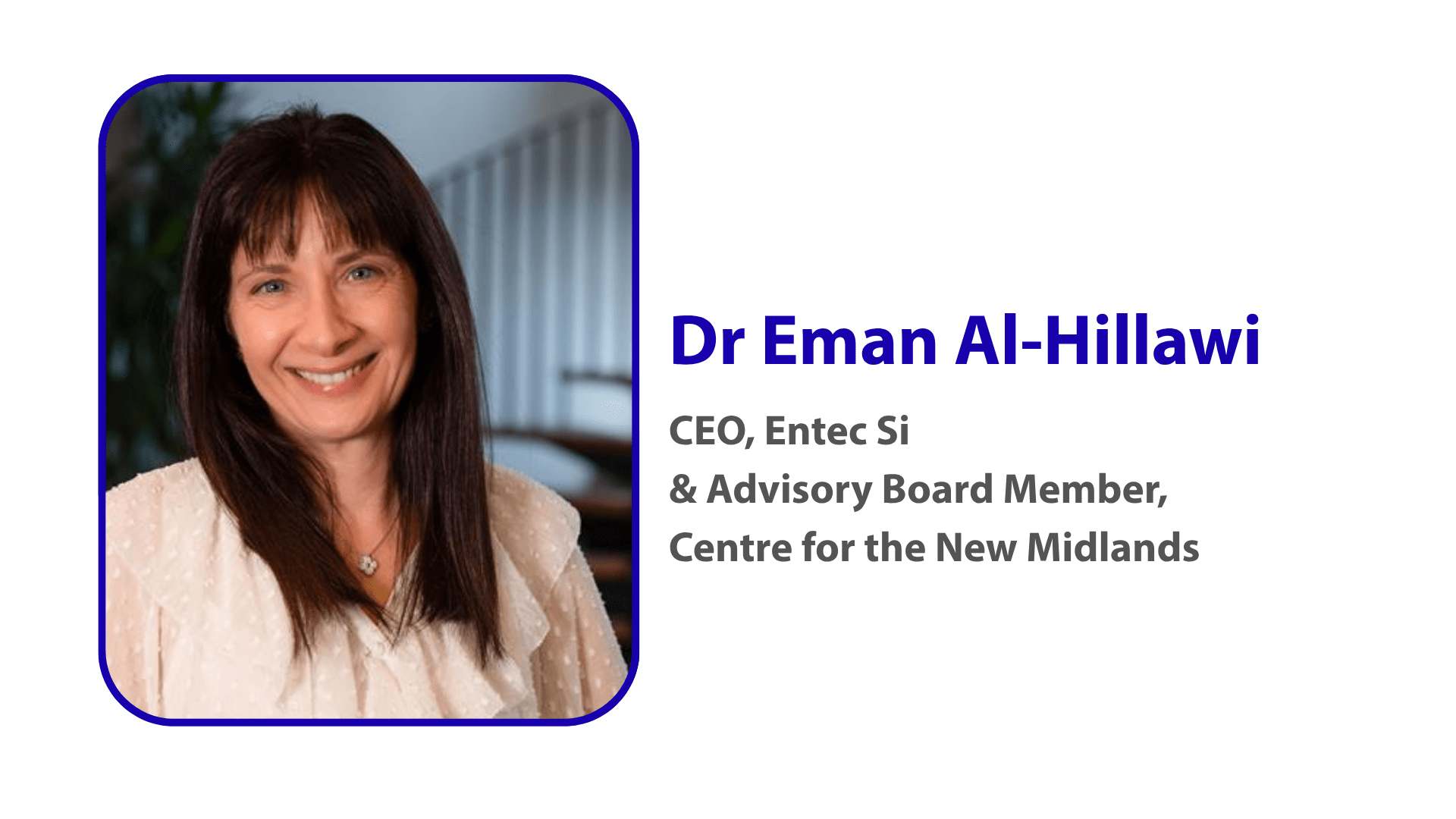
Eman is the CEO and co-founder of Entec Si, a Birmingham-based consultancy specialising in business change and digital transformation. With a PhD in Biochemistry from the University of Birmingham, Eman transitioned from science to IT in the late 1990s and has since led multi-million-pound programmes across local government, education, aviation, and healthcare. Living and working in the West Midlands, Eman sees the huge potential and challenges that businesses face. She is therefore proud to be on the Advisory Board of the Centre for the New Midlands, sharing her experience and helping to enhance its work to build a better region.
Eman is passionate about inclusive leadership and has built a people-first culture at Entec Si, where 62% of our team are women. She is a private pilot, an award-winning businesswoman, and a vocal advocate for diversity in tech. Her leadership is grounded in authenticity, empathy, and resilience, qualities Eman believes are essential for driving meaningful change.
About Entec Si:
Entec Si is a business change consultancy, specialising in technology and digital transformation.
Operating across a range of industry sectors, Entec Si has significant experience of leading business transformation, projects and programme delivery and people change. Entec Si has extensive experience in working within organisations to facilitate and lead projects and in managing effective business change within complex organisations.
It works with people to deliver meaningful change, analysing problems through insight and data and working collaboratively with clients to identify solutions, set goals and help to navigate the journey to deliver long-lasting change that place people at the heart of success.
Entec Si has particular expertise in local government, NHS, Not for Profit, transport and aviation sectors. Their professional consultancy services and unique blended team approach ensures that they consistently provide the best business outcomes for their clients.