“I would simply grow the economy”, said many a political leader since the 2008 crisis rocked our world. But why? And more importantly, how?
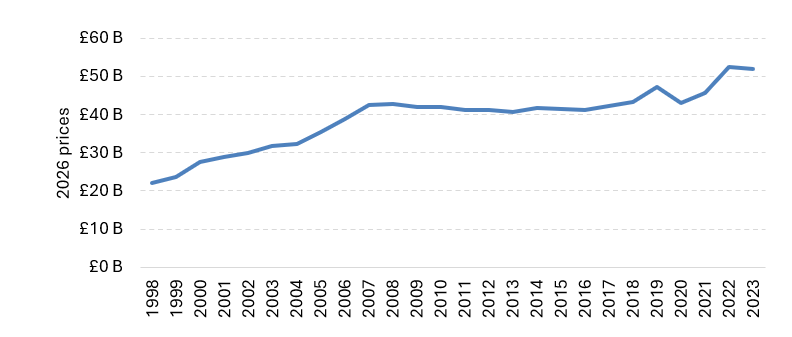
‘Why’ is straightforward. The West Midlands has punched below its economic weight for half a century, first as heavy industry declined and cities depopulated, but even recent times have seen our productivity ‘gap’ with the UK average widen. Using Gross Domestic Product per head of the population – a crude measure of productivity – our region was around 10% below the UK average in 1998, but a quarter century of later, that gap has doubled (see chart). Closing that gap overnight would add roughly £50 billion per year to GDP, which represents around £8,500 for every man, woman and child in the West Midlands. More than a number though, across the world productive economies tend to perform better on wider quality of life metrics like life expectancy, wellbeing or educational attainment.
Productivity ‘gap’, West Midlands versus the UK average [source: ONS & GDP deflator]
How the region’s economy catches up is harder to answer. Economic geography has obsessed our island at least since the Romans’ selectiveness when locating their cities, outposts and walls!
Mayors are being given responsibility for economic growth, but so far not all the tools to deliver it. A new report by the IPPR North which Arup supported argues that institutionally ‘advanced’ strategic authorities like the West Midlands Combined Authority (WMCA) should be given greater powers to determine their economic fate. This is key to WMCA delivering on its growth plan, which pledges to create 100,000 jobs, build 12,200 homes per year and improve transport links. Scaling up to deliver, we argue, would mean giving Mayors power to:
- Retain a greater share of taxes paid in this region;
- Invest more of the proceeds, over a longer time horizon, without excessive meddling and control from Westminster;
- Borrow to invest in growth-enhancing areas such as infrastructure.
What should Mayors prioritise with these powers? Resources are finite, and decisions ultimately come down to political judgement, but the choice of strategy is key.
‘Upskill your people’ frequently prevails in academic circles. By investing in the region’s so-called ‘human capital’, we equip tomorrow’s adults (and today’s) with skills to thrive. The opportunity is large, with the West Midlands being England’s youngest city-region outside London, but we also know there is a mountain to climb. Gaps in educational attainment form at an early age and often link to much deeper social problems like the region’s high child poverty rate. What’s more demand for skilled workers is hard to predict and plan for so perhaps we should instead take heart that England is holding its ground and moving up the international rankings in terms of school performance.
‘Unleash the forces of enterprise’ with a competitive tax and regulatory offering is another popular road. Places like Birmingham’s Paradise quarter benefited from being part of the city’s Enterprise Zone package of incentives and works. It succeeded because there was a clear story of which industries would cluster together and benefit from sharing resources and innovations – what economists call agglomeration externalities. Our universities also play a vital part in sustaining this growth, supplying the people and ideas, particularly in lucrative global growth industries like life sciences. There is however an opportunity cost to helping our region’s most promising places to do even better. Critics argue that towns on our region’s periphery, and even some inner-city neighbourhoods, do not get their ‘slice of the pie’ in terms of jobs and investment. That matters hugely if political support for growth is to be maintained.
Then there is ‘invest in better infrastructure’, which, if implemented well, tax and borrowing powers would enable. Few will have missed the jungle of cranes marking our skylines lately, and as someone working in a built environment consultancy, I am the first to welcome this. Transport, housing and regeneration connects people to opportunities and gives the West Midlands a denser economic ‘core’ for those agglomeration benefits to take hold and accelerate.
Sure, the benefits of new infrastructure take years to materialise, and operating and maintaining those assets costs money so decision-makers are rightly wary of sinking resources into vanity projects or boondoggles. But rewards from good investments are clear. Birmingham’s cross-city line is, relatively speaking, fast, frequent and popular – so much so that few living along the route could imagine life without it. Yet courageous decisions over electrification and capacity were taken in the 1970s and 80s when Brum’s economic slump was deepest and private car travel was overwhelmingly popular.
Transport, homes and commercial spaces go great together of course, and more of the time should ‘unlock’ the decisions to invest in each other. The next round of big infrastructure ‘bets’ like the Eastside Metro extension or a new rail line to Manchester will be easier to make if the full suite of opportunities are planned for and joined together early on. Aside from big bets, operational changes can deliver results in the short term, as we may now see with bus franchising in the West Midlands.
Skills, growth, infrastructure. Mayors could soon be taking powers to tie these strands together, deliver growth, and be held accountable for it by local people. Here we go.
This is a personal blog post. Any opinions, findings, and conclusion or recommendations expressed in this article are those of the authors and do not necessarily reflect the view of the Centre for the New Midlands or any of our associated organisations/individuals.
ABOUT OUR AUTHOR:
Joe Gaytten is a Birmingham-based economist and Associate Director at Arup. He was previously a senior civil servant at the Department for Transport and has also worked in HM Treasury and the Northern Ireland Office. He writes in a personal capacity.