Across the West Midlands, we know that rough sleeping is one of the clearest and most painful signs that something has gone wrong long before someone reaches a doorway, a tent or a car park. It is visible, urgent and unacceptable. But it is also complex.
As chair of the West Midlands Combined Authority Homelessness Taskforce, I want us to be ambitious about reducing rough sleeping, but also honest about what it takes. Accommodation matters deeply. Yet the work does not end when someone is handed a key.
Why promises to “end” rough sleeping need careful handling
Andy Burnham could not have been any clearer about his priorities in his first few hours as the UK’s new Prime Minister. On his first morning as PM he visited The Passage, a homeless charity in Westminster, and then announced from the steps of No10: “I will soon go through that door behind me and issue my first instruction: to end rough sleeping in our country”
It’s a bold statement of intent which shows how politically potent the problem of visible homelessness is. And minutes after he walked back through that door, the government announced £340m of new funding to tackle rough sleeping. 5.5 Million of this funding is coming to the West Midlands. The most recent snapshot count of people rough sleeping found 158 people sleeping rough on one night in across the West Midlands. That’s a rate of 5.1 people rough sleeping per 100,000 population, which is lower than the England rate of 8.2 people per 100,000.
National leaders have often made bold commitments to end rough sleeping. Those commitments matter because they signal priority, unlock funding and focus public attention. But they can also create unrealistic expectations if they suggest that a single announcement, funding pot or programme can resolve every cause of homelessness.
In the West Midlands, our task is to turn ambition into practical delivery: prevention, rapid response, suitable accommodation, specialist support and stronger communities around people who have experienced homelessness.
The lesson from past initiatives
Over many years, successive governments and local authority leaders have launched serious initiatives to reduce rough sleeping. They have helped many people and saved lives. But most have struggled to meet the public promise of “ending” rough sleeping altogether.
That should not make us cynical. It should make us clearer. But the public conversation needs to recognise that some people need more than housing supply alone: they need time, trust, treatment, relationships and a reason to believe that life indoors can be safer than life outside.
Part of the challenge is being clear about what we mean by “ending rough sleeping”. In the homelessness sector, the aim is often described as making rough sleeping rare, brief and non-recurring. That is the right benchmark. But the public can understandably hear the phrase as a promise that there will come a morning when no one is bedding down in a doorway anywhere in the region.
A better public conversation
Ambition matters. It helps drive change and keeps rough sleeping high on the public agenda. But ambition must be matched with clarity, because unrealistic expectations can leave frontline teams unfairly judged and communities feeling that homelessness is impossible to solve.
Our taskforce is not interested in slogans for their own sake. We are interested in what works: preventing people from reaching crisis, responding quickly when they do, and supporting people once they move from the street into accommodation. We have termed that designing out homelessness through systems change.
That means having a better public conversation about the causes of homelessness, the limits of policy alone, and the vital role played by councils, housing providers, charities, faith groups, health partners, businesses and residents across the West Midlands.
Facing the complex realities
It is tempting to think rough sleeping is fundamentally a question of resources: more money, more homes, more beds. Those are essential, and we need more of them. But the reality we see across the region is more complicated.
The pandemic showed what can be achieved when agencies move with urgency and common purpose. During the national Everyone In response, councils, charities, hotels, health services and community organisations worked at pace to bring people inside and keep them safe.
That effort was extraordinary. It showed the public sector and voluntary sector at their best. It also reminded us that people sleeping rough are not a single group with a single need: each person carries a different story, different risks and different hopes for the future.
The limits of resources alone
Everyone In showed both the power and the limits of resources. At that moment, more accommodation and support were made available than at almost any other point in recent history. Barriers were lowered, agencies worked quickly, and people who had been outside were offered rooms rather than only emergency beds.
That response saved lives and gave many people a safer place to stay. But it also taught us an important lesson: even when the system moves fast and resources increase, rough sleeping does not disappear overnight. For some people, accepting help is not straightforward; for others, accommodation alone cannot undo years of trauma, poor health, isolation or mistrust.
Three forms of poverty
One of the reasons rough sleeping is so hard to tackle is that it is rarely caused by a single problem. There is the poverty of resources: a shortage of genuinely affordable homes, low income, debt, insecure work, benefit problems and the pressure of rising costs.
There is also relational poverty: family breakdown, abuse, neglect, bereavement, loneliness and the loss of trusted relationships. Many people reach the street not only because they have nowhere to go, but because they feel they have no one to go to.
And there is poverty of identity: the damage caused when people lose confidence, purpose, self-worth and hope. Mental ill health, addiction and repeated trauma can make it harder to trust services, sustain a tenancy or believe that change is possible.
That is why homelessness is about more than the absence of a house. A house provides shelter, but a home also means safety, stability, belonging and connection. Our response has to recognise all of those needs.
In 20 plus years, I and the organisations I have worked for have worked with countless rough sleepers who were given a flat, but whose isolation drew them back to where they did have relationships. And however destructive it is, the daily challenge of surviving on the streets , even maintaining a drug addiction, does bring a sense of purpose which is more attractive than sitting alone in four walls.
What public leadership can do
Public leadership matters enormously. Government can set priorities, fund services, support councils, invest in prevention, improve access to housing and bring partners together around a shared plan. Combined authorities can help convene that work across boundaries so that people do not fall through the gaps between places or services.
Approaches such as Housing First have an important role, especially for people with the most complex needs. But no single model can carry the whole burden. We need a mixed response: prevention, outreach, emergency accommodation, supported housing, mental health and substance misuse support, move-on homes and long-term community connection.
Professional support is essential, but it is not the same as community. The question of who notices when someone withdraws, who shares a meal, who offers encouragement, and who helps someone feel they belong cannot be answered by commissioning alone.
Compassionate realism
That is why I believe we need compassionate realism. We should never lower our ambition, and we should never accept rough sleeping as inevitable. But we should be honest about the scale of the challenge and the fact that human problems need human relationships as well as public policy.
In the West Midlands, that means working across councils, housing providers, charities, faith and community organisations, health services, police, businesses and residents. It means preventing homelessness earlier, acting quickly when people do sleep rough, and staying alongside people after they move indoors.
The role of community
Across our region, there are powerful examples of people and organisations providing more than services. They are offering welcome, patience, practical help, friendship and hope. These are not soft extras; they are part of how people rebuild lives. We need safe accommodation, but we also need the relationships that help turn accommodation into home. We need investment, but we also need neighbours, volunteers, mentors, employers and communities willing to walk alongside people for the long haul.
A shared responsibility
Rough sleeping is a structural issue, a political issue and a human issue. It is shaped by housing markets, poverty, public services and policy decisions. But it is also shaped by trauma, relationship breakdown, poor health, addiction, loneliness and the loss of belonging.
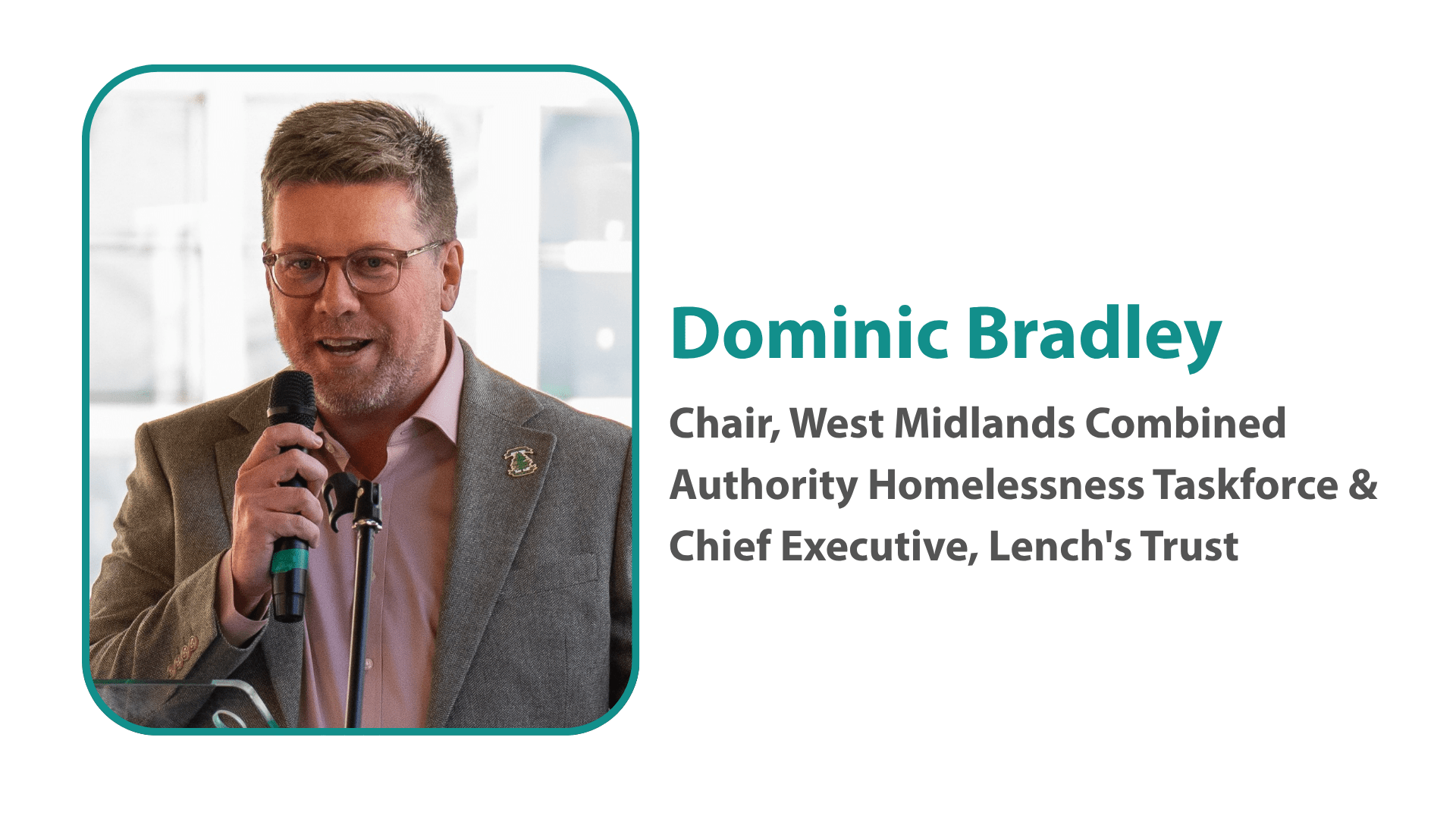
As chair of the West Midlands Combined Authority Homelessness Taskforce, my commitment is to keep bringing partners together around that fuller picture. We must push for better policy, more housing, stronger prevention and the right specialist support. But we must also build the relationships, trust and community that help people stay off the streets for good.
I really welcome our Prime Minster putting homelessness at the top of his governments agenda, let’s get to work.
This is a personal blog post. Any opinions, findings, and conclusion or recommendations expressed in this article are those of the authors and do not necessarily reflect the view of the Centre for the New Midlands or any of our associated organisations/individuals. The Centre for the New Midlands is a non partisan organisation, with an interest in representing policy positions from across the entire political spectrum.
ABOUT OUR AUTHOR:
Dom is the Chief Executive of Birmingham’s oldest charity, Lench’s Trust. He combines this with being the Independent Chair of the West Midlands Combined Authority Homelessness Taskforce and is the former Chair of the Birmingham Social Housing Partnership. He is an experienced housing and public service leader, bringing together local authorities, housing providers, and community organisations to address homelessness, improve housing outcomes, and drive strategic collaboration across the West Midlands. Dom is also a Member of the Centre for the New Midlands’ Housing and Communities Leadership Board.