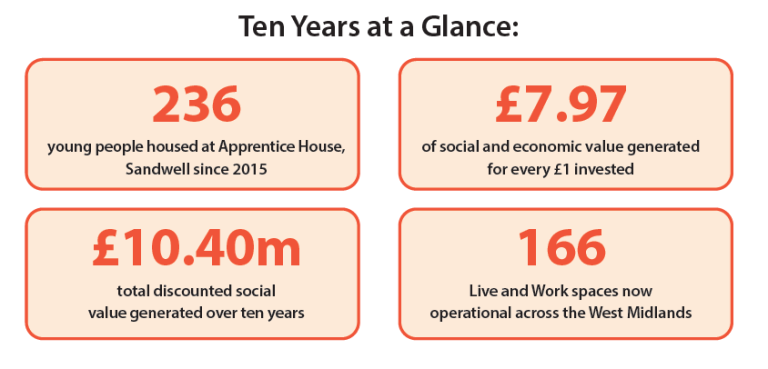
A major new evaluation published today by the Centre for the New Midlands (CNM) reveals that St Basils’ pioneering Live and Work model—designed to provide genuinely affordable, employment linked housing for young people—has delivered £7.97 of social and economic value for every £1 invested over the past decade.
The independent study, funded by the Oak Foundation, draws on ten years of service user data, a full Social Return on Investment (SROI) analysis, and extensive interviews with young people, staff and partners. It concludes that Live and Work is a proven, scalable solution to the deepening housing and employment crisis facing young people across the West Midlands.
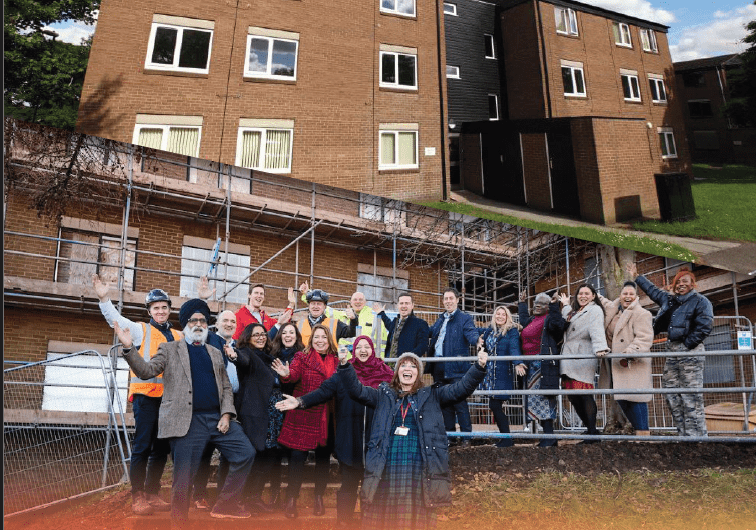
Since opening its first scheme in Sandwell in 2015, Live and Work has housed 236 young people, enabling them to sustain employment, save for the future, and transition into independent living—often into private rented homes that would otherwise have been inaccessible.
A model built on partnership and possibility
Reflecting on the origins of the scheme, Jean Templeton DL, Chief Executive of St Basils, said:
“When we first asked in 2013 how low a rent would need to be for a young apprentice to live and work without relying on benefits, the answer—£42 a week—seemed impossible. Yet through extraordinary partnership and determination, Live and Work was born.”
Jean added that the evaluation captures the heart of what the model achieves:
“One young person described Live and Work as giving them ‘the space to breathe’. That says it all. This is about creating the stability that allows young people to work, save and plan for their future. We hope this evidence inspires partners across the country to create Stepping Stone housing so every young person has the chance to thrive.”
Evidence of transformative impact
The evaluation highlights the structural barriers young people face: rising youth unemployment, unaffordable private rents, long social housing waiting lists, and the “benefits trap” created by high supported housing rents. Live and Work breaks this cycle by offering high‑quality accommodation at deliberately deflated rents, restoring the financial incentive to work.
Dr Halima Sacranie, Director of Housing Research at CNM and lead author of the report, emphasised the significance of the findings:
“Housing and employment are inextricably linked and cannot be solved in silos. The 10-year evaluation of the St Basils Live and Work demonstrates what becomes possible when these are addressed together.”
She continued:
“Young people told us that stability, affordability and control over their own space were transformative—reducing anxiety, improving wellbeing, and enabling them to sustain work and imagine a future. The SROI findings show that this is not only socially impactful but economically compelling.”
A compelling case for national replication
The evaluation shows that 88.6% of all social value generated benefits young people directly, through improved income, wellbeing, and long‑term life chances. Public services also benefit through reduced homelessness costs, lower welfare dependency, and reduced pressure on health and criminal justice systems.
Chris Smith, Founder and CEO of the Centre for the New Midlands, said the findings should act as a catalyst for national action:
“This evaluation provides one of the clearest cases yet for early, preventative investment in young people. Nearly £8 of social value for every £1 invested is an exceptional return, but behind the numbers are real lives changed.”
Chris added:
“Live and Work is a model that works—and one that can be replicated. Our hope is that this report gives policymakers, funders and housing providers the confidence and clarity they need to scale this approach across the UK. As the only independent think tank for the Midlands region, we are delighted to have worked with Jean and the fantastic team at St Basils on this evaluation study and look forward to working with other partners across the region who are looking to help shape a ‘better’ region for all”.
Key findings from the evaluation
- £10.40 million in discounted social and economic value generated
- £7.97 returned for every £1 invested
- Tenancy stability has doubled, with median stays rising from 6–7 months to 11–13 months
- 23% of residents moved into the private rented sector, a major achievement for young people without family support
- 76% of residents arrived from outside homelessness services, showing the model reaches working young people priced out of the housing market
- Significant improvements in wellbeing, mental health, autonomy and future planning
- Model proven replicable, with 166 Live and Work units now operating across the West Midlands
About the organisations:
St Basils, one of the UK’s leading youth homelessness charities, supports more than 4,000 young people each year across the West Midlands, helping them find safe accommodation, sustain employment, and build independent futures.
The evaluation was conducted by the Centre for the New Midlands, an independent, non‑partisan think tank dedicated to improving public policy, social outcomes, and economic opportunity across the region.
For further information on the report, please do not hesitate to contact Chris Smith (Founder and CEO, CNM) by emailing chris@thenewmidlands.org.uk or Dr Halima Sacranie (Director of Housing Research and Project Lead) via halima@thenewmidlands.org.uk
The report can be viewed below, or is available to download by clicking here