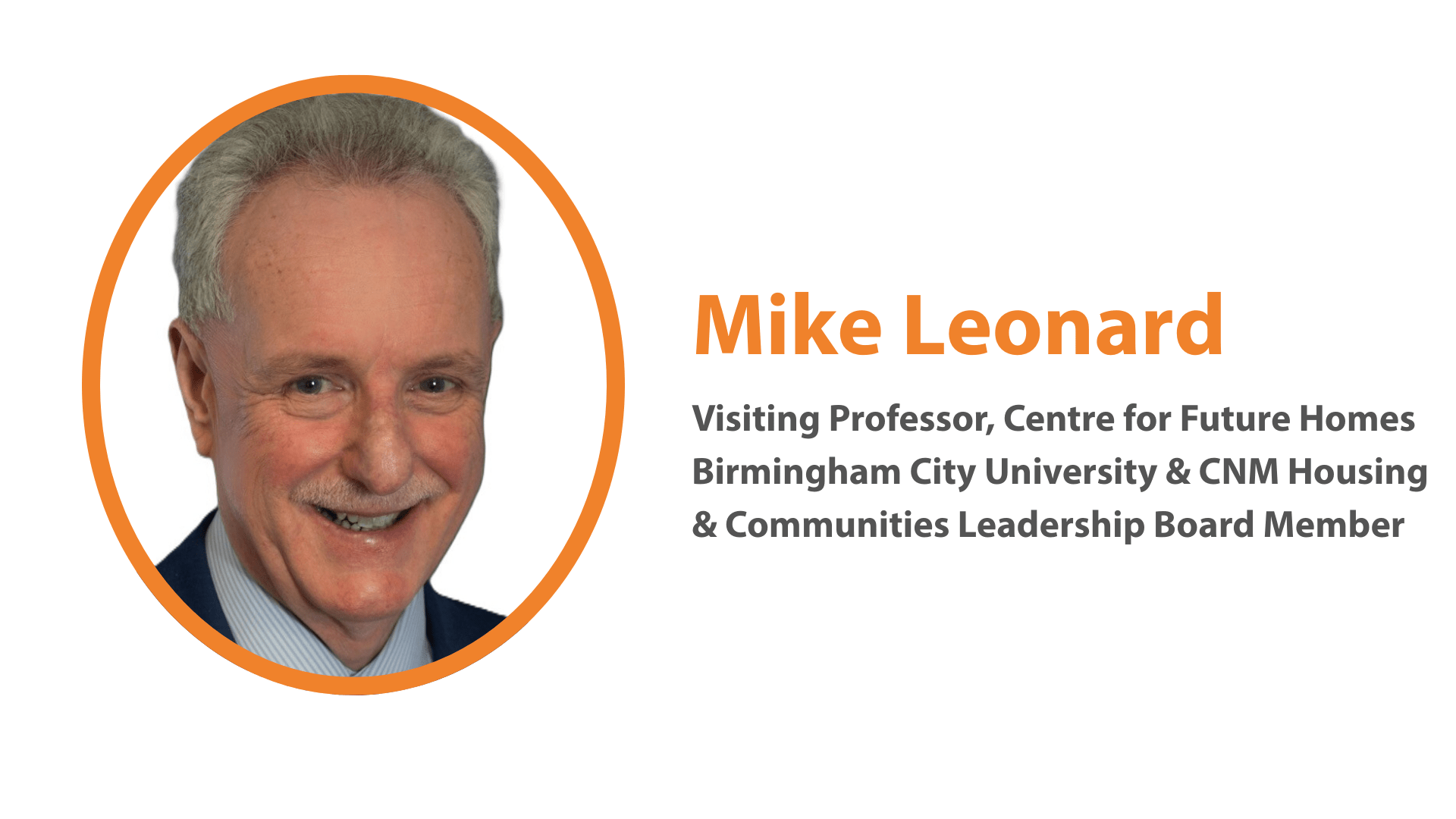
As the country heads toward a pivotal May election, Mike Leonard (Visiting Professor, Centre for Future Homes at Birmingham City University & CNM Housing & Communities Leadership Board Member) argues that incremental U-turns are no longer enough—and that it’s time for a decisive reset. In this hard-hitting piece, he warns of fraying social cohesion, rising unemployment and a deep crisis of trust in national leadership, while making the case for urgent, bold intervention to “Get Britain Building” once again. From the prospect of an emergency budget to a sweeping package of measures aimed at housing, jobs, manufacturing and local procurement—particularly in the West Midlands—Leonard sets out both the risks of inaction and a route back to growth and confidence. With voters angry, patience thin, and the region’s economic future at stake, this article challenges politicians and communities alike to act before the handbrake is forced on them.
As our government careers to the May election cliff edge, U turns are not working and it is the time to apply the handbrake, reflect on our priorities, reset and carry on. We must act now to prevent a breakdown in social cohesion, rising unemployment and attempt to grow our beleaguered economy.
Patience is running out, leadership of our country is result driven and just as we witness the departure of struggling football managers, the Labour party will act ruthlessly if the predicted collapse in the May elections comes to pass.
Trust and confidence are at all time low, and the people are craving inspirational leadership. The PM and the Chancellor must put the country before party and act now to Get Britain Building, harnessing the same opportunity that delivered growth and employment, following the Second World War and the 2008 economic crash.
An emergency budget may be necessary to deliver a range of measures to turn around the economy:
- An incentive scheme for first time buyers
- Removal of stamp duty for people under 30 and over 66
- Reverse the NI tax on jobs
- Scrap the inheritance tax changes for family businesses
- Cease the unfair bias towards MMC construction at the expense of UK masonry manufacturers
- Launch and support Made in Britain, through public procurement and incentives to make building products in the UK and support investment
- Support clean heat incentives and discontinue penalties on UK boiler manufacturers
- Introduce a salary rebate scheme for employers to part fund employees in their first 2 years of employment
- Invest to support UK manufacturers with a Made in Britain default in public procurement. We must ensure that we continue produce bricks and blocks and put down new plant to produce heat pumps, PV and batteries rather than being forced to source from China
Without access to the advice of the OBR is not possible to calculate the financial impact of the above changes. Clearly, we need to balance the budget and avoid additional borrowing. If required we believe the electorate are ready to accept a small increase on income tax, in exchange for jobs and growth and social inclusion.
The elections may well have a profound effect on the future direction of the West Midlands and our role as the manufacturing heartland of the UK economy. Unemployment in the West Midlands is currently around 5.9%, with roughly 184,000 people out of work, a slight improvement on the previous quarter but still higher than the UK average and youth unemployment is running at circa 18%. These numbers are set to rise as higher employment costs, a depressed economy and the transformational effect of AI take’s hold.
Add to this the cost-of-living crisis leading to food and fuel poverty and you have a perfect storm with voters poised to vent their roth. As is so often the case it is the local politicians who will face the anger of the voters often over matters where they have very little, if any, influence.
All is not lost, if our local politicians can demonstrate their commitment to do what is right for the region, to create jobs, growth and social cohesion. Access to good quality housing is a crucial factor as is the need to put local procurement of goods and skill labour at the heart of their agenda. The electorate will not tolerate huge amounts of public money being used to procure goods and services from overseas, whilst our local businesses and the jobs they support disappear.
Those wishing to play a direct role in local politics would do well to lobby for the above measures and clearly demonstrate to electors that they understand their current challenges and will make best use of their office to make the West Midlands, a better place to live and work.
This is a personal blog post. Any opinions, findings, and conclusion or recommendations expressed in this article are those of the authors and do not necessarily reflect the view of the Centre for the New Midlands or any of our associated organisations/individuals.
ABOUT OUR AUTHOR:
Mike has extensive senior leadership experience in building product manufacturing and housing. He is the CEO of the Building Alliance, a not for profit organisation that brings together a wide range building product manufacturers and promotes the benefits of resilient masonry construction. He is the current Chair of the West Midlands Social Housing Group and Birmingham Housing Week.
He is currently delivering primary research to support the transition to net zero and developing learning opportunities to improve building safety, ensuring resilience in the built environment, Mike frequently speaks at conferences and publishes material to shape future policy.
A founder and co-leader in the Birmingham City University “Centre for Future Homes” researching the Future Homes Standard through active Demonstrators, preventing overheating, enhancing indoor air quality, addressing the fire risk, reducing the use of single life plastics, decarbonising material manufacture, and embracing the skills gap. In a period of unprecedented change, Mike believes that it is critical that policy makers have the data and insights to make evidence-based decisions and avoid unintended consequences. He also believes it is critical that we put home occupiers at the heart of the journey and avoid unintended consequences.
Mike is committed to supporting the journey to net zero in new and existing Homes, supporting UK building product manufacture, improving efficiency and quality, prioritising safety, health and comfort. Ultimately, he believes in creating better places and neighbourhoods that harness nature and high-performance design and construction to deliver homes that are resilient to the economic and climate change challenges to meet the needs of future generations.