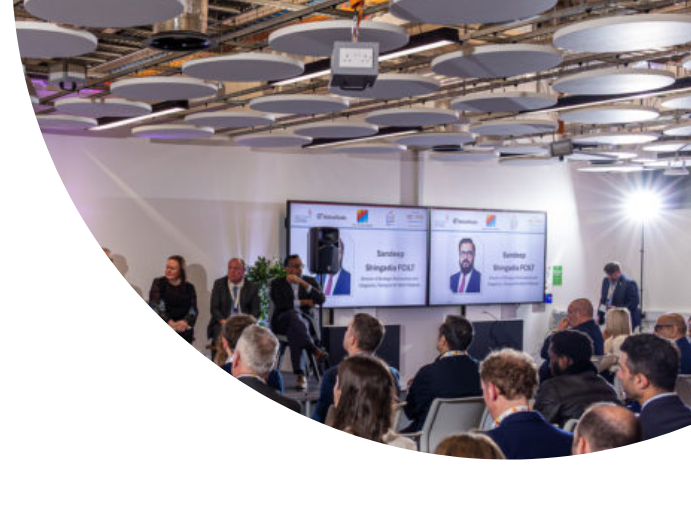

In this article, Joe Anthony (Account Manager – Planning and Built Environment, PLMR) provides some reflections on the Centre’s recent Connections for Prosperity: Beyond the Sport conference.
Big sporting events have tended to dominate conversations about regeneration. They bring attention, visitors and moments of civic pride.
But the real test comes after the event ends, when the cameras are gone and the stands are empty. If the places built around sport only work on matchdays, then regeneration has fallen short. That question sat at the heart of Connections for Prosperity: Beyond the Sport, the Centre for the New Midlands’ conference examining how sport is shaping places across the Midlands.
As media partner for the event, PLMR spent the day capturing proceedings, speaking to delegates and following these conversations as they unfolded. The message was consistent: successful places are the ones that still make sense when the crowds have gone home.
Designing for everyday life, not just the big moments
Sporting venues have often been designed to transform places on event days, rather than support everyday life. Throughout the day, speakers were clear that this approach needs to be reversed. Places should work first for residents and local businesses and then scale up when the big moments arrive.
Discussions lead by Birmingham City Football Club around the Birmingham Sports Quarter highlighted how critical this distinction is. Large venues can attract investment and attention, but without the right mix of uses around them, they risk becoming isolated assets rather than anchors for long term regeneration.
In practical terms, this means starting with ordinary days. How does the area function on a Tuesday afternoon? How do people move through it, use it and feel part of it when there is no match, concert or tournament?
Coventry Building Society Arena was discussed as a venue 20 years into its maturity, one of the UK’s first multi-purpose venues, which has been a catalyst for investment in the north of Coventry with the creation of retail, business parks and hospitality businesses.
Mixed use as the foundation, not the add-on
Across the day, mixed use development was framed not as an optional extra, but as the foundation that allows sports-led regeneration to deliver lasting value.
With retail no longer playing the anchoring role it once did, sport is increasingly being used to drive footfall and investment. But without homes, workspaces, local services and community infrastructure alongside it, that activity is temporary rather than transformative.
This also shifts how success is measured. Rather than focusing purely on attendance figures, the more meaningful test becomes whether local people choose to use the area when there is no event at all.
Legacy and learning from experience
Beyond design, there was a strong focus on delivery and governance. Regeneration linked to sport often spans decades, yet is shaped by political cycles, funding pressures and institutional change.
Experience from delivering major events has shown the value of continuity. Clear ownership, shared learning and governance structures that can endure beyond individual projects make the difference between sustained momentum and diluted ambition. This is reflected in places like Manchester, where the use of a Mayoral Development Corporation is helping drive what is set to be the UK’s largest sports-led regeneration programme at Old Trafford since London 2012.
This has clear implications for how sports-led regeneration is planned and communicated. Long term programmes require narratives that are honest about complexity and trade-offs, rather than presenting schemes as finished or frictionless from the outset.
What this means for sports-led regeneration
The discussions at the conference pointed to a simple but demanding test for sports-led regeneration. Success is not defined by a single event or a weekend spike in footfall. It is defined by whether places work in ordinary moments, for the people who live and work around them.
Sport can be a powerful catalyst for change, but only when it is embedded within places that function every day. That requires joined up thinking across design, investment, delivery and community use, not just during major events, but long after they have passed.
If sports-led regeneration works on a Tuesday afternoon, it will work on a matchday too. From the ambition set out around the Birmingham Sports Quarter and beyond, there is every sign that the region understands that test and is planning accordingly.
This is a personal blog post. Any opinions, findings, and conclusion or recommendations expressed in this article are those of the authors and do not necessarily reflect the view of the Centre for the New Midlands or any of our associated organisations/individuals.
ABOUT OUR AUTHOR:
Joe Anthony is an Account Manager at PLMR, specialising in public affairs and planning communications for major regeneration and infrastructure schemes.