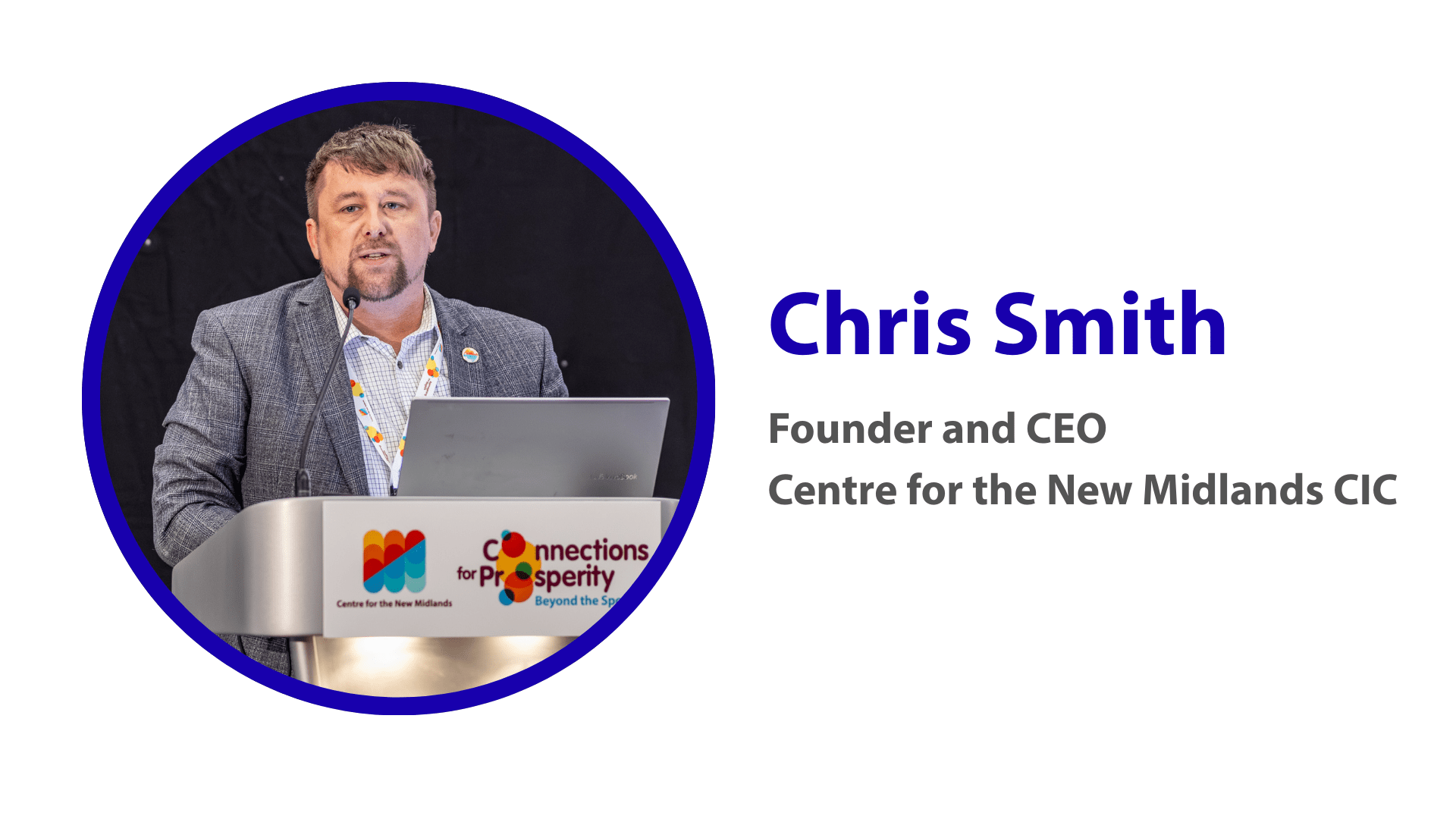
In this article, Chris Smith (Founder and CEO, Centre for the New Midlands) unpacks why May’s local elections may prove a defining moment for the West Midlands and the wider devolution agenda.
As we approach the local elections on 7th May, there appears to be a significant divide in the public mood, more so than in most typical local election periods. On one side, the mood is one of a real sense of opportunity and anticipation with the prospect of councils across the region changing to pantones never seen before; the established parties getting their respective kickings from the electorate. On the other side, there seems to be a real sense of anxiety and gloom, that the ‘new kids on the block’ will be elected in vast numbers and the current political order will be majorly disrupted in ways in which the region has barely seen before.
Yet beyond the immediate political contests, they represent something else: a moment that could reshape the balance of regional power, influence the effectiveness of the Combined Authority, and send important signals about the future direction of devolution across England – let alone what may happen at the next General Election.
A Turning Point for Regional Leadership
The West Midlands has long been at the forefront of the UK’s devolution journey; one of the true ‘trailblazers’. As one of the earliest areas to adopt a Combined Authority model with a directly elected Mayor, over the past ten years, the region has demonstrated how local leadership, when equipped with the right powers and resources, can deliver meaningful progress in transport, skills, housing and economic development.
This year’s elections are therefore not only about who leads individual councils, but about the collective strength of our regional governance.
The local elections matter because they will not only shape what happens in the localities of the ballot boxes, but the results will shape how effectively the West Midlands can speak with one voice when engaging with central government, investors and national institutions.
Richard Parker (Mayor of the West Midlands) has made several references to his collegiate approach throughout his time in office and that he has yet to take any major decision to a ‘vote’ due to his inclusive style of leadership. This line that the Mayor understandably likes to use, could go out of the window if the local electoral landscape changes significantly from 8th May.
The Balance of Power: Councils, Mayor and the Combined Authority
This often overlooked but significant consequence of local elections is the potential shift in political majorities across councils — and what that means for the balance of power within the Combined Authority itself.
As seen across other parts of the country and within our own region, the Mayoral model functions most effectively when there is constructive alignment, or at least functional cooperation, among constituent councils. Changes in council control can therefore have several implications:
- Decision-Making Dynamics
The way that the Combined Authority is structured relies on consensus and partnership (ie the WMCA Board’s membership consists of the Mayor, alongside the constituent and non-constituent local authorities, with voting rights restricted to the seven constituent members). Therefore, change in political leadership across several councils can either strengthen collective momentum or introduce new priorities that slow or redirect existing programmes. Neither outcome is inherently negative and a reflection of the so called ‘will of the people’, but both require strong leadership and negotiation skills to maintain regional cohesion.
- Strategic Direction and Policy Emphasis
Different political majorities bring different policy emphases — whether on housing density, transport investment, environmental priorities or business support. A shift in council leadership can alter the strategic tone of regional policy, influencing how funding is allocated and which initiatives receive political backing. The attitude of political parties more broadly to the devolution agenda and what it means for their local authority and their politics, may impact the collaborative approach between the CA and its member authorities.
- The Mayor’s Mandate and Influence
While the Mayor is directly elected by the public, their practical effectiveness depends on relationships with council leaders. A supportive council landscape can accelerate delivery and unlock innovation. A more fragmented political environment may demand greater diplomacy and compromise, but it can also enrich debate and ensure broader scrutiny of major decisions. It also leaves the door wide open for much more political point scoring and the national political agenda moving into the regional sphere.
- Public Perception of Regional Governance
Whilst voter turnout is still fairly low at a mayoral level, inevitably voters increasingly expect visible outcomes from devolved leadership and the costs that go with devolved government – particularly at a time when the public sentiment indicates a desire for less government. If council changes result in clearer collaboration and stronger delivery, public confidence in the Combined Authority grows. Conversely, visible discord can risk undermining faith in the devolution model itself — regardless of the merits of individual policies.
I think it is worth stating that Devolution has never been solely about constitutional reform; it is about practical power and localised decision making. At its best, devolution is about putting more power and resource back into the hands of people who know their areas best and providing a democratic process to ensure the people’s priorities are reflected in the way decisions are taken locally. Through negotiated settlements with Westminster and the advent of the Single Settlement, the West Midlands has secured greater control over transport funding, adult education, and aspects of economic development. These are not abstract wins — they translate into real initiatives such as the extension of the Metro, new train stations, Levelling Up Zones, retraining opportunities, public control over the bus network and targeted business support to name just a few.
However, these powers are neither static nor guaranteed. Their expansion depends on demonstrating that regional governance works: that decisions are transparent, delivery is effective, and collaboration transcends party lines. The relationship between Whitehall and the regions has moved away from the ‘parent-child’ relationship to a more mature relationship with genuine fiscal devolution now being seen as the next legitimate phase of devolution. The May elections could well play a pivotal role in either reinforcing or recalibrating that perception.
Implications for the Broader Devolution Agenda
What happens in the West Midlands does not stay in the West Midlands. Our region is frequently viewed as a bellwether for the success — or otherwise — of English devolution.
In this sense, local election results are not merely regional events; they are signals to the rest of the country about whether devolved leadership can deliver sustained prosperity.
Political debate is both natural and healthy – and absolutely central to a functioning democracy. Yet across party lines, one would hope that there remains a shared recognition that the West Midlands possesses formidable strengths: world-class manufacturing and engineering capability, a growing innovation ecosystem, a leading centre for professional services, a diverse and youthful population, and a network of towns and cities with distinctive identities and assets. One would hope that there is a common purpose to tackle youth unemployment, provide better and more integrated transport solutions and to enhance the quantity and quality of the region’s housing stock – to name just a few of the key areas of regional policy.
At the Centre for the New Midlands, we will continue to champion collaboration, evidence-based policy, new ideas and long-term thinking. Electoral cycles will come and go, but the underlying mission remains constant: ensuring that the West Midlands is empowered to shape its own future.
Whatever the outcome at the ballot box, one truth endures — the trajectory of our region will not be determined by Westminster alone. It will be shaped here, by the quality of our local leadership, the strength of our partnerships, and the engagement of the communities we serve.
This is a personal blog post. Any opinions, findings, and conclusion or recommendations expressed in this article are those of the authors and do not necessarily reflect the view of the Centre for the New Midlands or any of our associated organisations/individuals.
ABOUT OUR AUTHOR:
Chris is the Founder and CEO of the Centre for the New Midlands, launching the organisation in January 2020. Prior to establishing the only independent, non-partisan think tank solely focussed on the West Midlands region, Chris worked for 15 years in the UK Higher Education sector, with extensive experience in student recruitment, stakeholder engagement; business development and major gift fundraising.
Chris has previously worked for the Saga Group plc and the Home Office, Immigration and Nationality Directorate. Chris is a former Students’ Union President and has also been a Trustee of a Students’ Union.
Chris has served as a member of the NSPCC Business Board in Coventry and Warwickshire and is currently an Acorns Children’s Hospice Business Ambassador. He is an avid Tottenham Hotspur supporter and a ‘Man of Kent’ by birth but an ‘adopted’ Coventrian having lived in the city since 2003.