

As birth rates plunge and populations age worldwide, Dan Pontefract (expert in leadership, corporate culture, and organizational performance) explores how societies are shifting from a stable “bell-curve” of young workers to a top-heavy “light-bulb” demographic that could upend economies, workplaces, and the future of growth.
Since time immemorial, our society and the workplace have followed a rhythm as predictable as three chords and the truth. Generations arrived, grew, and contributed to society, each replenishing the one before. It was normal, as normal as a bell curve distribution.
Now, picture a different bell, a regular church bell—a shape wide at its middle, a bit wider at its base, and narrowing towards the top.
This shape reflected the natural order of things. A broad foundation of children—people procreating as per the norm, whatever that was—a robust middle of working-age adults, and a manageable, smaller top of retirees until people died.
The bell defined how economies functioned, anchored our institutions, predicted the workplace career ladder, and shaped our assumptions about the future.
Today, society is evolving into the demographic shape of a light bulb. We are shifting from bell-shaped to bulb-shaped.
The Bulb Enters the Demographic Chat
The bulb tells a very different story.
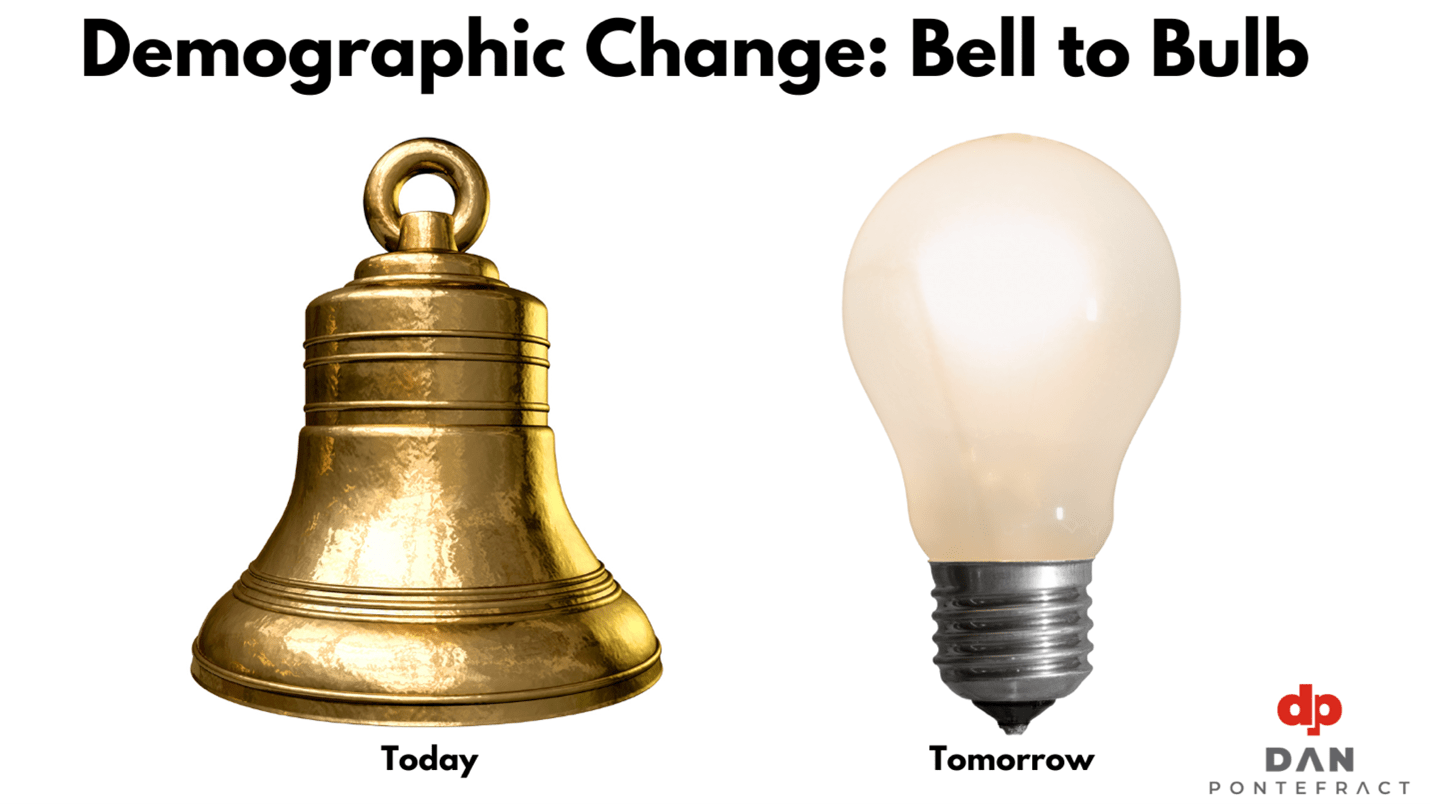
The bulb’s narrow base reflects plummeting birth rates, leaving fewer hands to carry the load forward. Its constricting middle—the working-age population—stretches thin under rising pressures and shrinking cohorts. The top of the bulb inadvertently swells. People are living longer—hooray—but with unintended consequences.
Healthier lifestyles have transformed retirement from a quiet exit into an extended, active phase of life—but this transformation hasn’t yet extended to work itself. This reimagining signals a recalibration of humanity’s entire structure, and society (and leaders) remains woefully unprepared for what lies ahead.
The bell is no longer ringing. And your organization is likely unprepared for what is to come in the silence.
Country Examples
Japan is perhaps the clearest example of the demographic canary in the coal mine.
There, the shift is so dramatic that adult diapers now outsell infant diapers. Nearly 30 percent of Japan’s population is over 65, a demographic reality already straining healthcare systems, pension funds, and the very fabric of Japanese society.
Even more pronounced, Japanese workers aged 55 and older will account for 40 percent of the workforce by 2031. There is no relief in sight either. In 2025, the country’s national fertility rate fell to 1.15, the lowest in its history.
South Korea faces a potentially starker challenge: with a birth rate of just 0.76, it is a country literally running out of children to sustain its future. Remarkably, by 2030, South Korea’s population aged 55 and over is expected to make up approximately 55 percent of the total population, surpassing even Japan’s.
Across Europe, pension systems built for a bell-shaped society are cracking under the weight of the bulb as more retirees depend on fewer workers. In my home country of Canada, where immigration has helped bolster population growth, the birth rate has fallen to 1.25—far below the replacement threshold necessary to keep the population at today’s level.
All that immigration in Canada is merely delaying the inevitable. The Great White North, too, will eventually run out of people.
And in the UK?
Don’t look now, but across the whole of the United Kingdom, fewer babies are being born, whilst the number of deaths has decidedly increased.
According to the Office for National Statistics (ONS), the total fertility rate—the average number of children women will give birth to across their child-bearing life—decreased in 2025 to 1.41 in England and Wales, while dropping even further to 1.21 in Scotland.
This represents a 20 percent decline since 2007 and one of the lowest fertility rates in the nation’s history. The demographic forecast paints a similar bell-to-bulb scenario unfolding. In fact, the UK firm Resolution Foundation predicts that in 2026, deaths will outstrip births, further warning that there will inevitably be fewer people of working age, which will correspond to higher taxes.
Immigration has sustained population growth—much as in Canada—with immigrants accounting for 65 percent of UK population growth between 2004 and 2023. However, various political issues—e.g. Brexit—leave an inevitable demographic apocalypse unaddressed.
In addition, according to the Centre for Ageing Better, the number of people aged 65 and over in the UK is projected to increase by 3.3 million in the next 20 years and by 6.5 million in the next 40 years.
Fewer workers mean slower economic growth, increased pressure on social programs, and diminished global competitiveness. The United Kingdom will soon share the same dim light as the other bulb nations.
Big in Japan
Japan’s demographic canary is also chirping about its lack of GDP growth due to government policy paralysis. The country’s situation will likely worsen as its workforce and society continue to age.
Jun Saito is a senior research fellow at the Japan Centre for Economic Research. In an interview with me at his Tokyo office, he sternly cautioned about Japan’s economic future.
“The potential GDP growth rate is eventually going to zero, and it could even fall below zero,” he warned me.
Saito explained that while temporary boosts to labour force participation—such as more women and older adults entering the workforce—have helped delay economic stagnation, they were insufficient to counteract the more profound demographic shifts.
By 2008, Japan’s population had already begun to decline, following decades of plummeting birth rates. By then, Japan’s economy was in a precarious state, its slowly shrinking workforce unable to support meaningful GDP growth.
The real puzzling aspect, as Saito outlined, is that Japan’s fertility rate fell below the 2.1 replacement rate in 1974, more than half a century ago.
What’s Next?
Why aren’t young people having children in Japan, South Korea, Canada, the U.S., the UK, or other countries across Europe?
The reasons are stacking up: the cost of living, unaffordable housing, fewer partnerships and marriages, and delayed parenthood, which narrows the window of opportunity for fertility. Add in a significant drop in teen pregnancies, too.
Whatever the causes, for the first time in human history, more societies are grappling with population stagnation or decline than explosive growth. I use terminology like “demographic tidal wave” for a reason—it’s a slow, desperate transformation unfolding before our eyes.
It will reshape how organizations operate, how corporate culture is activated, how leaders build teams, and how the work gets done.
But society is nowhere near ready for the reality of what is slowly yet inevitably happening. Sooner rather than later, it will come to bite.
This is a personal blog post. Any opinions, findings, and conclusion or recommendations expressed in this article are those of the authors and do not necessarily reflect the view of the Centre for the New Midlands or any of our associated organisations/individuals.
ABOUT OUR AUTHOR:
Dan Pontefract is a renowned leadership strategist, author, and keynote speaker with over two decades of experience in senior executive roles at companies such as SAP, TELUS, and Business Objects. Since then, he has worked with organizations worldwide, including Salesforce, Amgen, Nestlé, Virgin Media O2, Autodesk, BMO, the Government of Canada, Manulife, Nutrien, and BDO, among others.
As an award-winning and best-selling author, Dan has written five books: WORK-LIFE BLOOM, LEAD. CARE. WIN., OPEN TO THINK, THE PURPOSE EFFECT, and FLAT ARMY. His most recent, Work-Life Bloom, is the 2024 Thinkers50 Best New Management Book and the Gold Medal Winner of the Axiom Business Book Awards. He also writes for Forbes and Harvard Business Review.
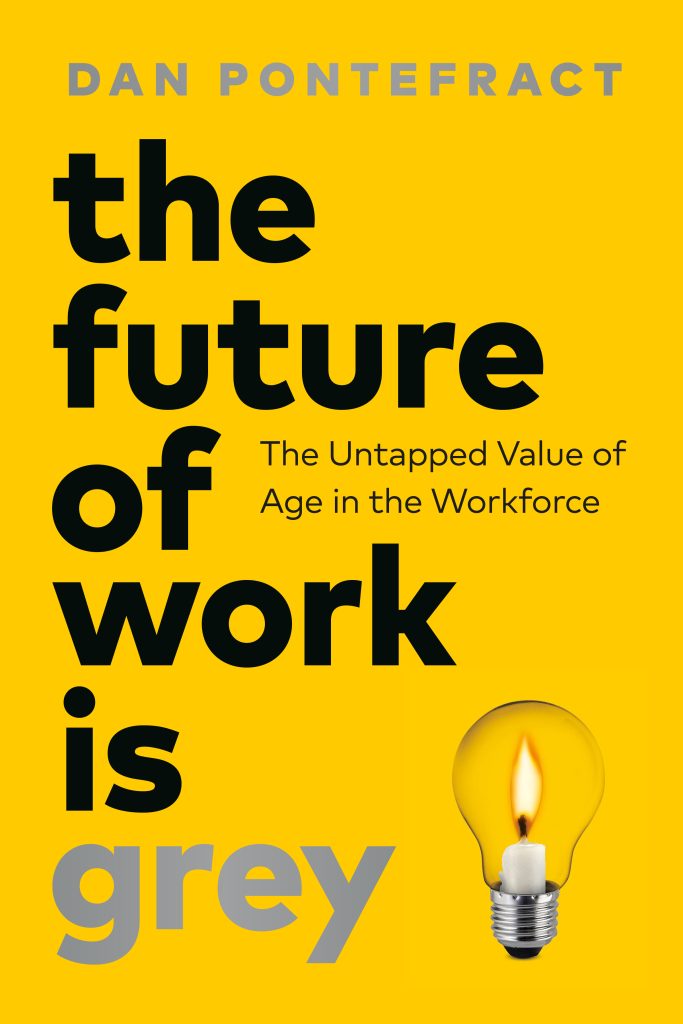
His highly anticipated sixth book, The Future of Work Is Grey: The Untapped Value of Age in the Workforce, is slated for publication on May 5, 2026.
Dan is a renowned keynote speaker who has presented at four TED events and has delivered over 600 keynotes. He is an adjunct professor at the University of Victoria’s Gustavson School of Business and has received over 25 industry, individual, and book awards.
Dan’s career is interwoven with corporate and academic experience, coupled with an MBA, B.Ed, and multiple industry certifications and awards. Notably, Dan is listed on the Thinkers50 Radar, HR Weekly’s 100 Most Influential People in HR, PeopleHum’s Top 200 Thought Leaders to Follow, and Inc. Magazine’s Top 100 Leadership Speakers.
“THE FUTURE OF WORK IS GREY: The Untapped Value of Age in the Workforce will be published on May 5, 2026, and it’s Dan Pontefract’s sixth and arguably most important book yet.” Click here for more information